
No credit card required. The free plan stays free.
On this page
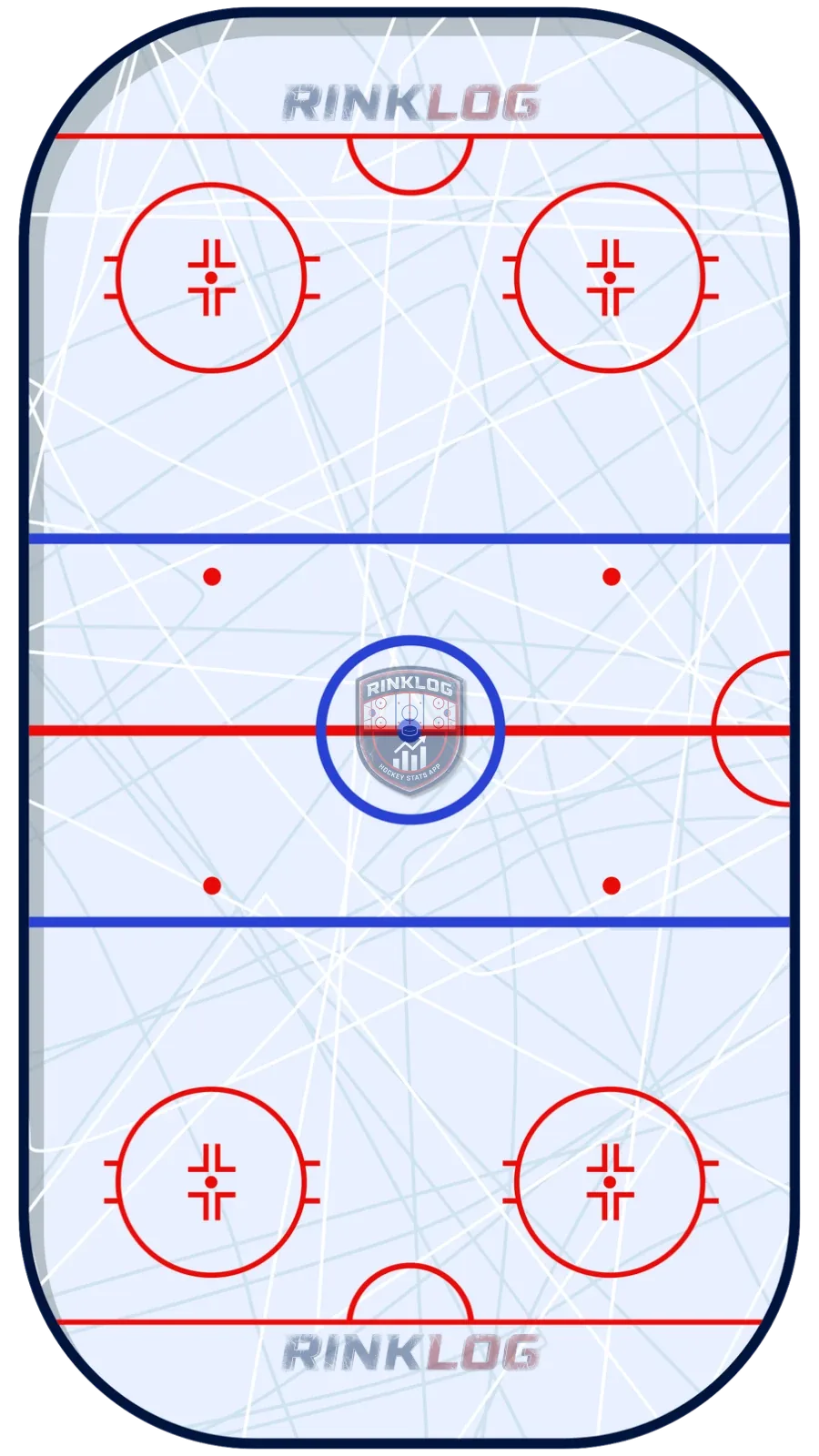
Phase 1 / 4Offensive zone
Lined up at the left circle: our center (C) faces the opposing center (X1) at the dot, ready to win the draw straight to D1. RW sets up inside the circle on the center-ice side; LW waits lower, on the boards side, ready to drive to the net. D1 is stationed at the blue line, D2 on the other side. X4 and X5 already mark our wingers, and X2 stands between D1 and the net.
- Our team
- Opponents
- Pass
- Shot
- Puck
The starting alignment is always the same. The center lines up at the dot, both wingers set up outside the circle, one on the boards side and one on the center-ice side, and both defensemen hold the blue line, one on the strong side where the puck needs to come out and the other in support on the far side. From that shared base, the choice of play comes down to one question: does the center expect to win the puck cleanly, or tie up the opposing stick and let the wingers fight for the loose puck?
The featured play on this page, the inside winger draw, shows that logic well. The center deliberately wins the draw to the offensive defenseman while the winger positioned inside the circle climbs above it and pops back out to the boards, still covered. The defenseman then carries the puck toward the middle while faking a point shot: the fake moves the opposing coverage, opens up the boards, and the lateral pass that follows gives the winger a clean shot through the traffic in front of the net.
The other won plays answer different needs. The roll out has both wingers cross to confuse a coverage that presses hard on both defensemen, while the end around brings the puck out low instead of high. The off-side shot answers a different read from the center: sensing he will only tie up the opposing stick, the two wingers often swap positions so the boards-side one gets a quick shot on net. The San Jose slide scrambles the picture by sending a winger to the far post while the center fakes toward the net and drops back into the high slot, wide open. Four up stays a late-game play, bringing four players in front of the net in the closing seconds; the tie-up for possession, on the other hand, works anytime, against a center who keeps dominating the other at the dot, betting on a scramble rather than a clean win. Even deep possession, where the center deliberately lets the draw slide toward a corner to spring a trap with both wingers already in position, keeps its place, as long as it is not used more than once or twice a game.
On a lost draw, two reactions shape the reply. The double press has the center climb high into the slot while a winger cuts through the circle to immediately pressure the opposing defenseman who just picked up the puck, forcing him to the outside rather than the middle. The 1-2-2 force applied to a lost draw goes further: one winger presses in the corner, the other covers the far wall, and the center locks the middle lane, ready to keep pressing into the neutral zone if the opponent tries to break out.
One thing separates a reliable center from the rest, watched from the stands: does he win cleanly, or does he tie up smartly when he senses he is about to lose the duel? Both count as tactical wins, even though only one shows up clearly on the scoresheet. Tracking every faceoff won and lost in RinkLog, game after game, reveals whether the technique is improving or the center is only winning against weaker opponents.
None of these plays replaces the center's individual technique at the point of contact, but each one gives the other four players a clear role before the puck even hits the ice. That preparation, more than any improvised read, is what turns a simple faceoff into a built scoring chance.
- The inside winger draw works because of the defenseman's shot fake, not a perfect shot
- Tying up the opposing stick sometimes beats forcing a risky, clean win
- Deep possession should only be used once or twice a game, or the opponent adapts to it
- On a lost draw, the wingers' reaction speed matters more than their exact positioning
RinkLog measures and computes all of this automatically during your hockey, ball hockey and ringette games.
No credit card required. The free plan stays free.
Frequently asked questions
Why does a center sometimes let the opponent win the faceoff?
That is deep possession: the center deliberately sacrifices the draw toward a corner so both wingers, already in position, can pounce on the opposing defenseman who just picked up the puck. The surprise often forces a quick turnover. Save it for once or twice a game, or the opponent starts expecting it.
What should you do when your center dominates the opponent at every faceoff?
The book still suggests using deep possession occasionally against that kind of opponent: it gives a strategic escape hatch even while giving up the draw on purpose, and it keeps the opponent honest instead of predictable on every duel.
Why track offensive-zone faceoff percentage separately?
A center can post a solid overall percentage while being weak in one specific zone. Isolating the offensive zone shows whether the prepared plays (inside winger draw, roll out) are actually working, or whether the center is only winning draws in the neutral or defensive zone.
The free plan lets you create a player and track their games with no credit card.
Create my free accountOn the same topic
- Why do neutral-zone faceoffs matter so much?The seven plays for a won neutral-zone faceoff and three reactions to a lost one, long overlooked but decisive for launching a fast breakout.
- How do you cover a lost defensive-zone faceoff?The Five Across alignment, used on roughly 80% of lost defensive-zone draws, plus the breakout plays for a win, from the simplest to the riskiest.
- How do you calculate faceoff win percentage?Calculating a center’s faceoff win percentage, the benchmarks (50%, 55%) and why this statistic improves with technique.
- What are the main hockey systems?The main families of hockey systems: breakouts, forechecks, neutral zone, attack zone, defensive coverage, special teams and face-offs, explained simply.