
No credit card required. The free plan stays free.
On this page
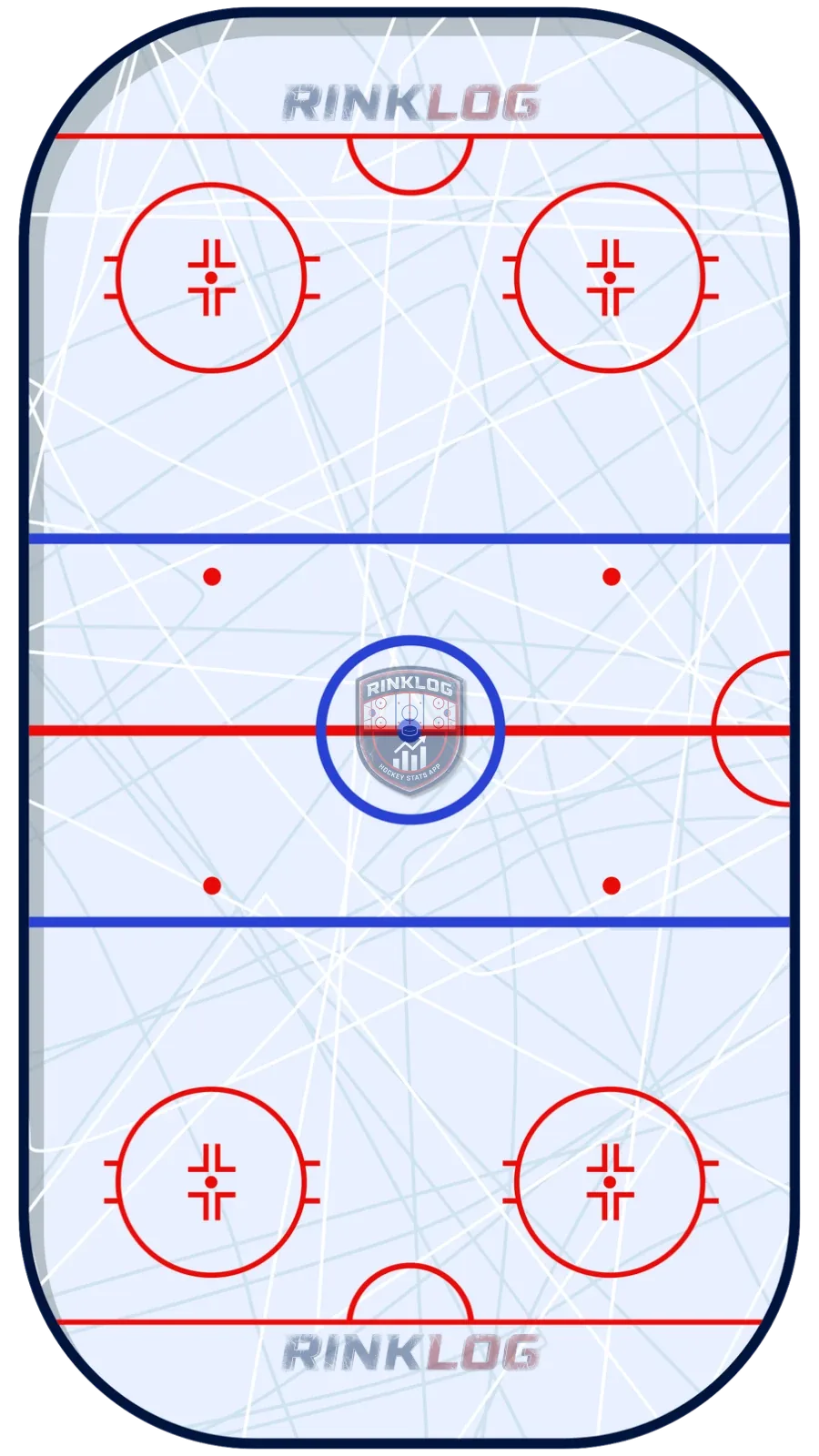
Phase 1 / 4Full ice
Base 2-1-2 shape, the system made famous by the 1980s Edmonton Oilers: F1 and F2 both committed deep, F3 high between the two defensemen, D1 and D2 at the offensive blue line, ready to pinch.
- Our team
- Opponents
- Pass
- Shot
- Puck
F1 pressures the carrier to force the puck along the boards or across to his partner, and usually gets the chance to finish his check. Once the puck moves, F1 retreats on the same side of the ice, leaving the rest of the work to the others.
F2 drops on the weak side anticipating a pass to the other defenseman; if the puck instead comes up his own side, he backs up without crossing the ice. F3 holds a high position between the two defensemen, ready to skate to the blue line and backpedal like a defenseman the moment either one pinches. On a turnover, F3 is already in good defensive position but also becomes a threat in the prime scoring area; he sometimes jumps up offensively, and F1 or F2 then pivots to retake the high spot.
Both defensemen read the play and anticipate the moment the puck comes up the wall: they pinch quickly on the winger without letting him by, finish their check under control, then return to the blue line right away. A pre-pinch position, a third of the way down the wall, shortens the distance to cover.
The system reacts differently depending on the opposing breakout. Against a cross-ice pass, F2 closes rapidly on the new carrier while F3 either cuts the central lane or fills the blue line, depending on what the opponent decides. Against a carrier circling the net, it is F2, not F1, who blocks the full loop and forces a pass along the boards. Against a corner-to-corner rim, the defenseman on the side the puck lands pinches, always covered by F3 rotating up to that blue line corner.
The system's strength is that constant physical pressure, which limits the exit lanes available to the opponent and forces the breakout back through a crowded middle. Its documented weakness: a defenseman pinching at the exact moment a forward retreats leaves the carrier rushing back against a forward, generally less solid than a defenseman at defending a rush the other way.
At exactly what moment does a defenseman decide to pinch? That is the system's hinge point, shift after shift, the single detail that separates a controlled forecheck from a costly one. RinkLog locates every forced clear and every rush allowed, two numbers that show over a full game whether the 2-1-2's physical pressure actually pays off more than it costs.
- F1 and F2 finish their checks rather than just containing
- F3 stays high between the defensemen, ready to play defense
- Pre-pinch position: a third of the way down the wall
- Only one defenseman pinches at a time, never both
- Known weakness: a defenseman pinching the exact instant a forward retreats
RinkLog measures and computes all of this automatically during your hockey, ball hockey and ringette games.
No credit card required. The free plan stays free.
Frequently asked questions
Why is the 2-1-2 associated with the Edmonton Oilers?
Because this physical pressure system, with two deep forwards finishing their checks, was made famous by the 1980s Oilers, a team known for its speed and aggressiveness on the forecheck.
What is the 2-1-2's main weakness?
A defenseman pinching at the exact moment a forward drops back on defense: the opponent can then rush back against a forward, generally less solid than a defenseman at stopping a breakaway.
The free plan lets you create a player and track their games with no credit card.
Create my free accountOn the same topic
- What are the hockey forechecking systems?Hockey forechecking systems explained: the 1-2-2, 2-1-2, left wing lock, torpedo and control forecheck, with strengths, weaknesses and counters.
- What is the 1-2-2 forecheck?The 1-2-2 forecheck in hockey: F1 deep, F2 and F3 wide at the circles, defensemen who never pinch on a direct pass. Strengths, weaknesses, counters.
- What is the torpedo system in hockey?The torpedo system in hockey: two forwards buzz corner to corner, one safety defenseman, and a center who has to defend like a defenseman when needed.