
No credit card required. The free plan stays free.
On this page
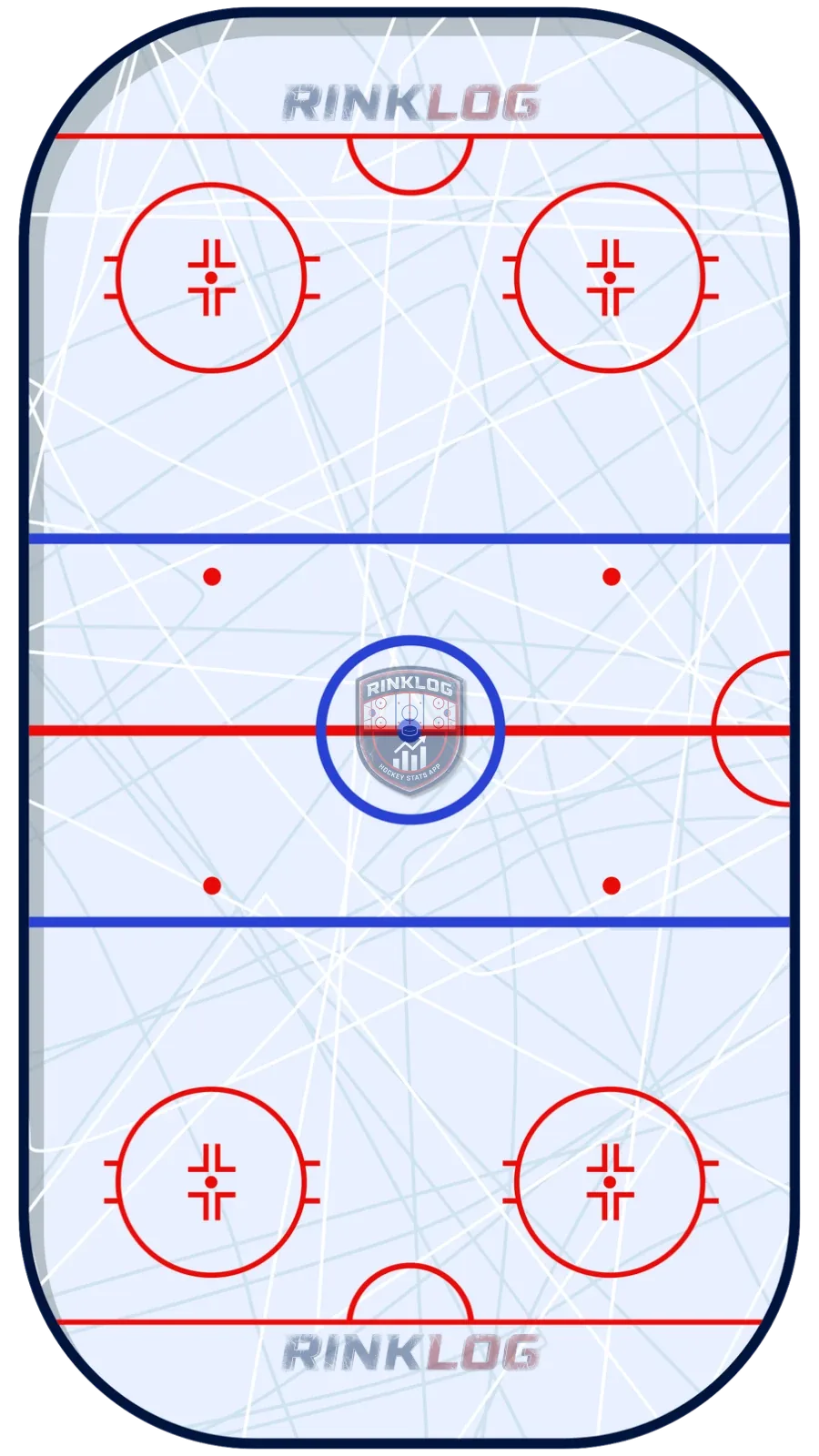
Phase 1 / 5Full ice
Base positions: D1 behind his own net with the puck, D2 in one corner, F1 in the other, F2 at the defensive blue line and F3 stretched at the offensive blue line. Facing them: one killer pressuring the puck, one closing the middle lane and two defensemen backing up in tandem.
- Our team
- Opponents
- Pass
- Shot
- Puck
All five complete breakouts start from the same picture. The puck-carrying defenseman sets up behind his net, a second defenseman takes one corner, a forward takes the other corner slightly higher, a fourth player waits near the defensive blue line and the fifth stretches to the offensive blue line. If the opposing forecheck does not press or is changing, the carrier can pick the puck up and leave immediately.
The single swing is the base version: both corner players swing to their side while the two high players cut across the ice. The carrier has four reads: the wall on one side with inside support, the wall on the other side, an early pass to one of the two players cutting across, or carrying it himself and rimming it up a side. The execution note is three words long: get open early.
The Dallas cut adds a fake. The carrier stops dead, fakes the wide pass to the corner forward, then immediately threads an inside pass to the trailing forward, trying to split the two opposing defensemen. Without the fake, the defense reads the inside pass directly. The Canuck center-lane option chases the same idea another way: a forward cuts through the middle to receive, enters the zone with possession, then moves the puck back outside once defenders collapse on him.
The last two breakouts change the logic. Five back brings everyone home to the puck before moving up as a block, with two players on the walls and two in the inside lanes: the carrier draws the coverage to the middle, then opens it up to the speed coming wide. The drop pass relies on a trailer: while the carrier crosses the blue line and pulls a killer with him, a forward who left late from deep in the zone arrives at full speed in the space that opened.
When the puck is already in the neutral zone, skating all the way back wastes precious time. Two regroups exist for that. The winger cross has two forwards swing to opposite sides while building speed, with a third stretching long. Up the gut sends a defenseman up a wide lane to pull a killer outside, then passes inside to a forward arriving through the middle from behind the play.
Every one of these breakouts has a counter. An aggressive one-man forecheck at the net front forces the carrier to decide fast. A two-man forecheck closing the middle and one wall takes away both five-back options. A killer assigned to the trailer cancels the drop pass. During the game, count how many power plays reach the offensive zone with possession: that is the most telling breakout statistic, and RinkLog lets you rebuild it from the timestamped events of the game, since every shot and goal is logged with its situation in the scoring app.
- One breakout per unit, executed perfectly, beats five half-learned ones
- The two high players must get open early, not as the pass leaves
- The wide pass fake is what opens the inside pass on the Dallas cut
- The drop pass trailer has to genuinely delay to remain an option
- Watch for offsides: anticipating the rush puts the high players offside
RinkLog measures and computes all of this automatically during your hockey, ball hockey and ringette games.
No credit card required. The free plan stays free.
Frequently asked questions
Do you always have to start from behind the net?
No. If the opposing forecheck is not pressing, or is changing players, the defenseman can pick the puck up and leave immediately. Waiting behind the net without reading the pressure is precisely the most common mistake on this play.
Which breakout should a minor hockey team pick?
The single swing, in the large majority of cases. It already contains four different reads from one setup, which leaves plenty of room to adapt to pressure without memorizing a second pattern.
The free plan lets you create a player and track their games with no credit card.
Create my free accountOn the same topic
- How does a hockey power play work?How a hockey power play works: breakout, zone entry, overload, 1-3-1 and split setups, five on three, four on three, and realistic success rates.
- What are the main hockey systems?The main families of hockey systems: breakouts, forechecks, neutral zone, attack zone, defensive coverage, special teams and face-offs, explained simply.
- How does the 1-3-1 power play work?The 1-3-1 power play: all five spots, the four options from the book, why it is so hard to defend and how a box coverage counters it.