
No credit card required. The free plan stays free.
On this page
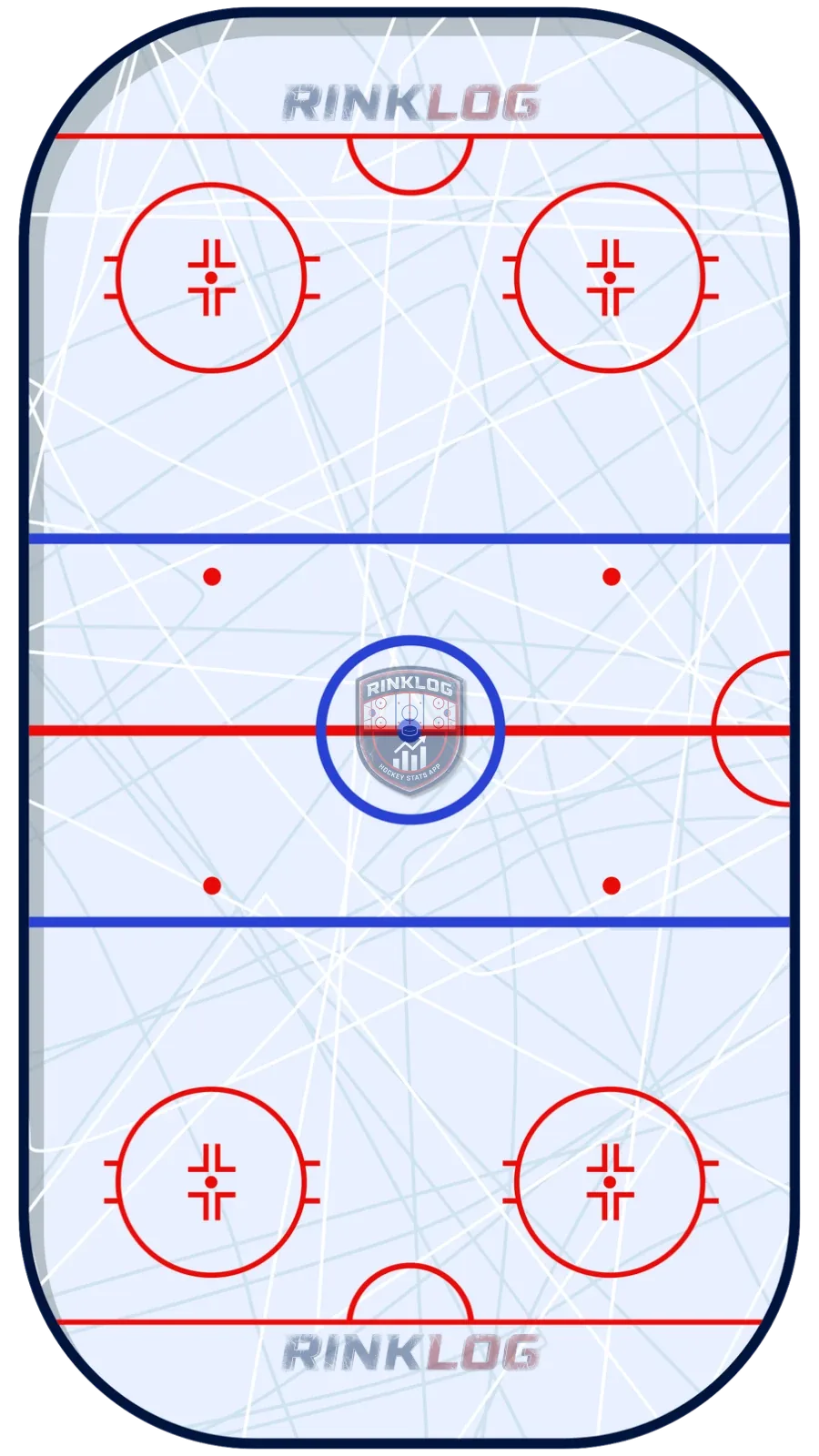
Phase 1 / 5Offensive zone
1-3-1 setup: D1 alone at the point, F1 and F2 on both half-boards, D2 in the slot, F3 at the net. The four killers hold their box.
- Our team
- Opponents
- Pass
- Shot
- Puck
Every spot has a clear mandate. The two half-boards players are the quarterbacks: right shot on the left, left shot on the right, a constant shot or pass threat. Under pressure their priority is not to force a play through the box, but to move the puck up to the point man. The box opens more often after a rebound recovery than after a forced pass.
The point man sits in the middle of the ice, feet on the blue line to give himself space. The puck rotates around him: he slides with deception to find a lane, works the puck left to right when the shot is not there, then resets to shoot again. The slot player, often a defenseman sliding in, has to move in space to distract the coverage and stay ready either for a quick shot on one side or a tip off a shot pass on the other.
Four options come out of that base. The point shot: the puck goes up, across to the far half-wall, then back to the point for the shot. The half-boards shot or cross-ice pass, which exploits the seam that is so often available on the power play. The inside play, where the half-boards player fakes the shot and threads it into the slot. And the low-release play, where the net man breaks free to receive low, then picks between inside, weak side and driving the net himself.
The strength of the 1-3-1 lies in its side-to-side options, which make life miserable for aggressive penalty kills. Every time a killer steps out to pressure a high player, he vacates a lane. The system works only if all three high players genuinely hunt the shot: that threat is what forces the box to step out and opens the slot.
The weaknesses can be countered spot by spot. A kill that assigns its low defenseman to cut cross-ice passes removes the most productive option. A killer charging the point on reception takes the shot away. An opponent parked in the slot neutralizes the inside play. A defenseman glued to the net man the moment he releases removes all three low-release reads. The cross-seam pass is also demanding: badly threaded, it becomes a short-handed break the other way.
The 1-3-1 is identified at first glance by the player planted in the slot: that is what separates it from the overload and the split. Count the shots that actually leave the three high players, then the pucks recovered after each shot. With RinkLog every shot carries its origin zone, so after the game you can tell whether the unit used its inside lanes or just circled the perimeter.
- All three high players must constantly hunt the shot or the one-timer
- Under pressure, move the puck up rather than force a play through the box
- The point man keeps his feet on the blue line to create space
- The slot player has to stay ready at all times, even after long puck movement
- The net man must read when to release, neither too early nor too late
RinkLog measures and computes all of this automatically during your hockey, ball hockey and ringette games.
No credit card required. The free plan stays free.
Frequently asked questions
Why is the 1-3-1 so popular?
Because it gives two symmetrical strong sides. The puck can live on either half-wall and change sides either up high or behind the net, forcing the opposing box to move constantly instead of camping on one side.
Should the slot player be a defenseman or a forward?
Both work. The manual describes that spot as a defenseman sliding in or a forward in defensive mode stepping into the slot once the puck is controlled. What matters is the shooting side: one handedness looks for the quick shot, the other for the tip off a shot pass.
The free plan lets you create a player and track their games with no credit card.
Create my free accountOn the same topic
- What is the overload power play?The overload power play: four players on the strong side, a half-boards quarterback, the six options from the book, and the ways to counter it.
- How does the split power play work?The split power play: two defensemen on the blue line, two half-boards players, a net man, five options, and the free switch into an overload.
- How does a hockey power play work?How a hockey power play works: breakout, zone entry, overload, 1-3-1 and split setups, five on three, four on three, and realistic success rates.