
No credit card required. The free plan stays free.
On this page
Phase 1 / 4Full ice
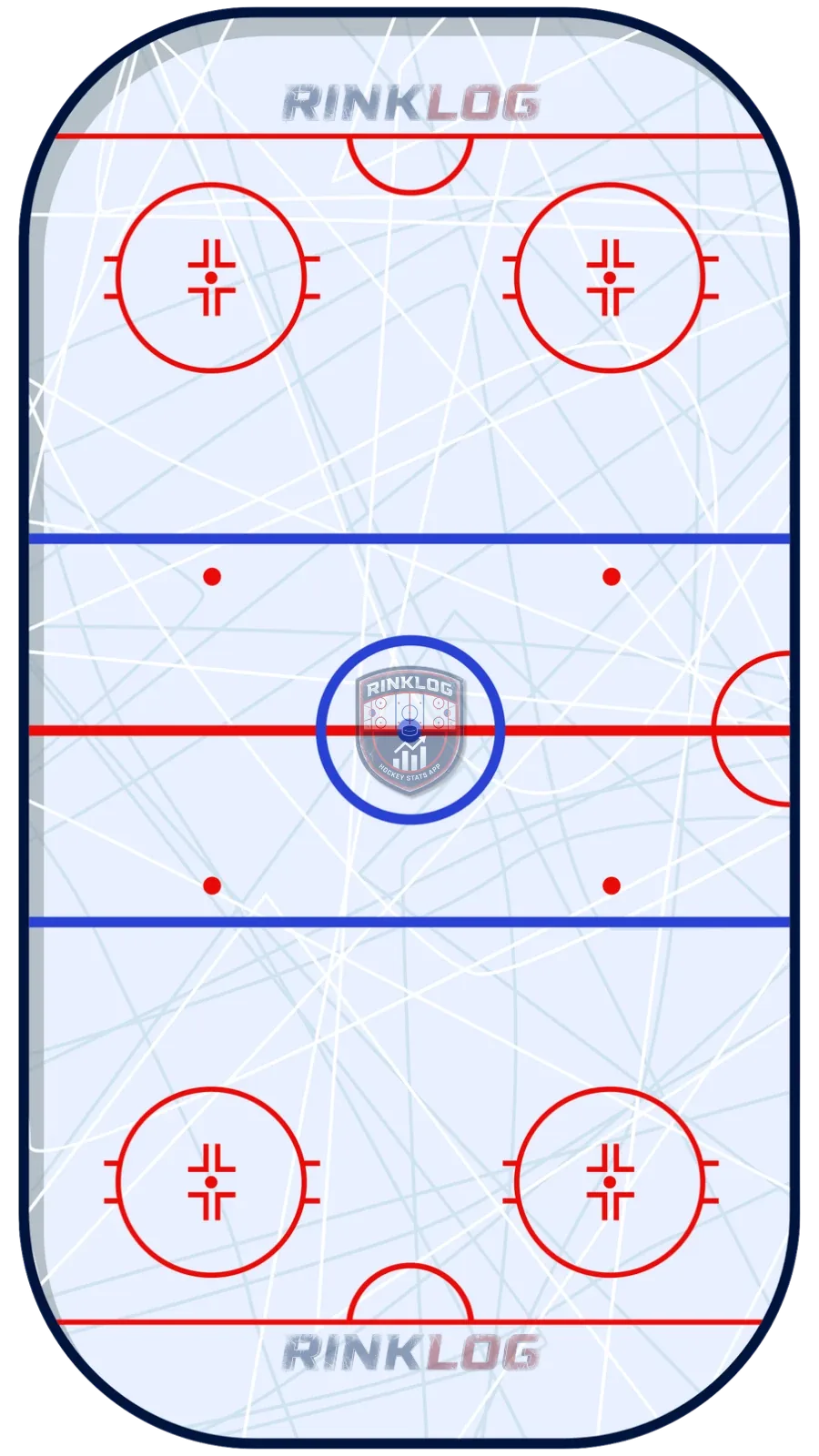
Base 1-2-2 shape: F1 engaged deep on carrier O1, F2 and F3 wide near the circles, D1 and D2 high at the offensive blue line. Only one forward is committed deep, which limits the risk of an odd-man rush back the other way.
- Our team
- Opponents
- Pass
- Shot
- Puck
F1 arrives fast on the carrier and takes an angle that limits his options: either he denies him the back of the net and turns him toward the wall, or he finishes a check to separate the carrier from the puck. If the puck moves in the direction F1 was already skating, he does not finish his check and instead keeps pressing the pass.
Against a direct breakout up the wall, F2 and F3 first hold their wide position before reacting. The instant the pass leaves for the winger, the forward on that side closes the space quickly: too early, he opens a lane to the middle; too late, the opponent has time to make a play. The other forward then gives up his wide spot to lock the middle of the ice, while F1, his check finished, retreats high above the puck.
Both defensemen never pinch on a direct pass to a winger: it is a non-negotiable principle of the system. They only step down on a long rim from corner to corner, and in that exact case the high forward on the same side has to fill their spot immediately. The system thereby deliberately invites the opponent to break out along the wall, then takes it away the moment he commits to it. That is what makes it a good pick for a cautious coach: the risk of a rush the other way stays low because only one forward is ever committed deep and four players always stay above or level with the puck.
The system also reacts to the other breakout types: against a cross-ice pass, the strong-side forward drops down to cut it off while the other shifts to block the breakout on the far side. Against a carrier circling the net, F1 judges the distance and cuts in front rather than chasing the whole way around if he has lost the angle. Against a reversal, F1 retreating high on the far side stays, per the book, the single most important detail in the whole sequence.
Its documented weakness: a defense able to make a precise pass through the middle of the ice beats the system, because the 1-2-2 leaves slightly more time and space for that kind of play than its more aggressive cousins. The most common mistake stays F1 hanging on to his check instead of retreating, or a defenseman pinching against the rule.
The timing of the forward closing on the winger stays the most telling moment in the whole system, shift after shift: half a second early opens the middle, half a second late hands the opponent a play. RinkLog timestamps every forced clear and every offensive-zone turnover, enough to see over a full game whether the 1-2-2 actually produces chances or just puck movement.
- F1 cuts off options with his angle, never with speed alone
- F2 and F3 hold their wide lane before reacting to the pass
- Defensemen never pinch on a direct pass to the winger
- F1 retreats high the moment his check is finished
- Only one forward is ever committed deep at a time
RinkLog measures and computes all of this automatically during your hockey, ball hockey and ringette games.
No credit card required. The free plan stays free.
Frequently asked questions
Why is the 1-2-2 considered the most cautious forecheck?
Because only one forward ever commits deep at a time and defensemen never pinch on a direct pass. The risk of a rush the other way stays low, at the cost of a little more room left in the middle of the ice.
How do you beat the 1-2-2?
With a precise pass through the middle of the ice. The system leaves a little more time and space for that kind of play than the more aggressive 2-1-2 or torpedo.
The free plan lets you create a player and track their games with no credit card.
Create my free accountOn the same topic
- What are the hockey forechecking systems?Hockey forechecking systems explained: the 1-2-2, 2-1-2, left wing lock, torpedo and control forecheck, with strengths, weaknesses and counters.
- What is the 2-1-2 forecheck?The 2-1-2 forecheck, popularized by the 1980s Oilers: two forwards deep, one player high between the defensemen, coordinated defenseman pinches.
- What is the neutral zone trap in hockey?The neutral zone trap explained: definition, history (popularized in the 1990s, the Devils, European hockey), how it works, and its documented weakness.