
No credit card required. The free plan stays free.
On this page
Phase 1 / 3Full ice
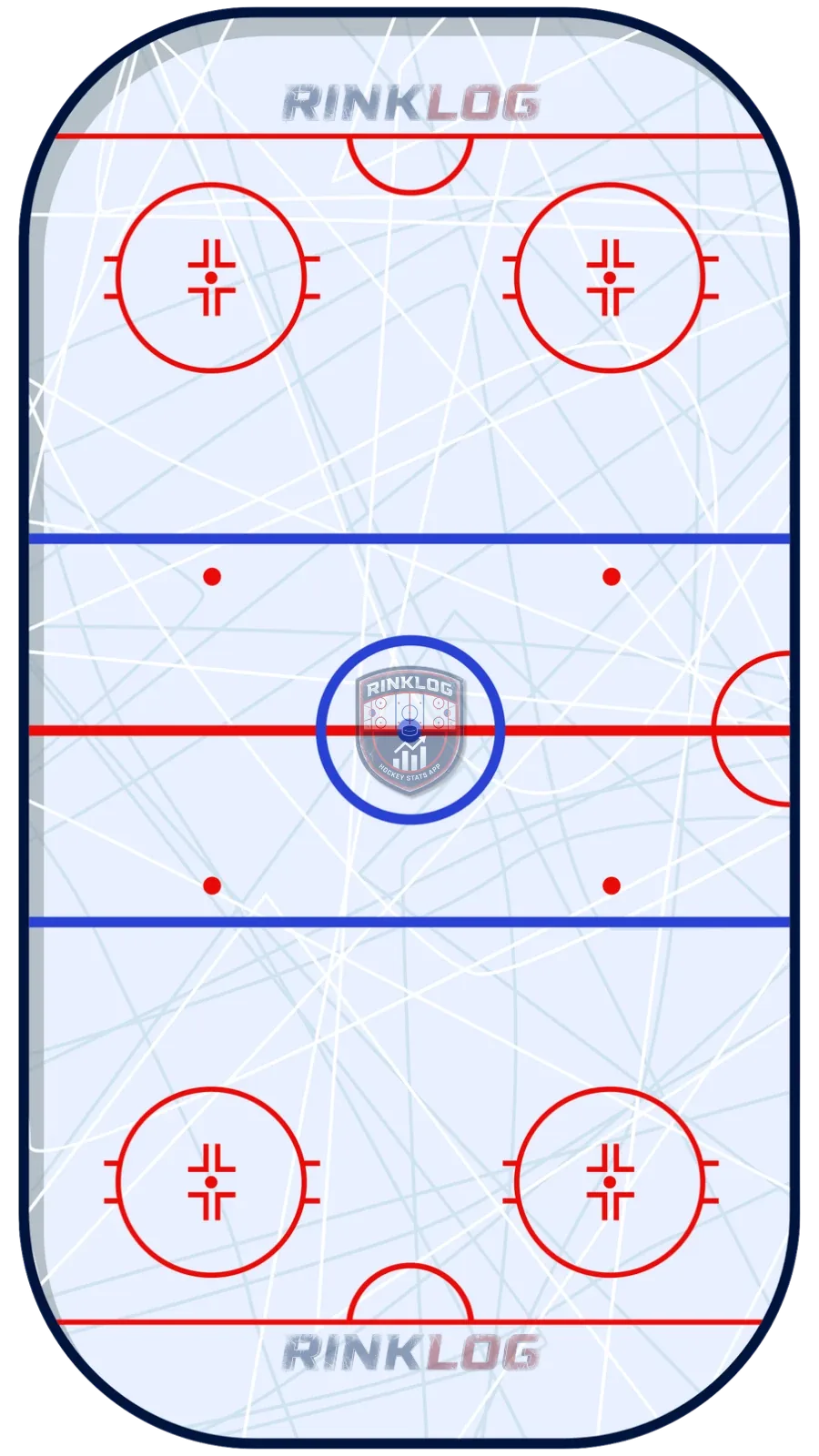
D1 receives the puck just inside the defensive blue line while the opposing forecheck is already organized in the neutral zone: X1 and X3 press the flanks, X2 holds the middle between them. RW has already stretched far to the weak side, ready to support the other side once the first pass leaves.
- Our team
- Opponents
- Pass
- Shot
- Puck
The two families are distinguished by the state of the opponent the moment the puck changes hands. A counter-attack exploits an opponent not yet retreated: the puck carrier advances it quickly toward the forwards to create an odd-man rush, with a targeted 50 percent success rate for the advancing pass, considered excellent by the book. A regroup instead answers an opponent already set up in a recognized forecheck system (2-1-2, 1-2-2 or 1-3-1), which requires knowing that system in advance to know which options will be open.
The most rewarding transition play remains the penetrating pass: the defenseman who just won the puck feeds it directly to a forward who has reached the stretch zone, the farthest possible space without being offside. Two conditions make it possible: the defenseman has to recognize the option right away, and the forward has to time his arrival with speed. A variant flips it: it is the forward without the puck who slips in behind the opposing defensemen, especially effective against a defense that pinches; even if the pass never comes, his mere availability forces the opponent back and opens up other areas.
Activating defensemen through the neutral zone adds a passing option, one more player for the opponent to cover, and a forecheck that backs off and gives the carrier more time. Three documented ways: the back-side option, where the defenseman who did not pass climbs straight up as a late option once the strong-side pass is gone; pass-and-go, where the defenseman follows his own pass into the vacated space for a quick return; and the mid-ice two-on-one, where the far-side defenseman slides diagonally to offer close support to the center. The decision to activate a defenseman always rests on the quality of possession, never automatic.
Against a forecheck already organized, two broad regroup families exist, both effective regardless of the opposing system. Lane regroups keep the center in the central lane at all times, with the strong-side winger supporting near the wall and the weak-side winger stretching far. Motion regroups instead let the center swap lanes with a winger, which produces more speed on the reception at the cost of less predictable positioning. Either way, the quick up stays the first read: the moment the defenseman receives the puck inside his own blue line, an immediate pass to an open forward keeps the opponent from having time to close its trap.
If the quick up is closed off, the read sequence follows a set order: the D-to-D stretch to the partner, then, if both wingers and the center are covered, a flat cross-ice pass to the weak-side winger who has slid low. With no option at all, the hinge play returns the puck to the first defenseman, back in mid-ice, to relaunch from the other side; the skating hinge, where that defenseman keeps retreating instead of waiting still, stays superior because it draws in a checker and builds speed. Under immediate pressure, chipping the puck behind the checker instead of trying to hold onto it is almost always the right read.
A counter-attack is recognized by how fast it executes in one or two passes; a regroup, by the discipline of routes repeated shift after shift. The real success rate of the penetrating pass is not something to guess at, it shows up in RinkLog once every advance and every neutral-zone turnover is dated and located, the only way to know whether a team is actually hitting that 50 percent target the book aims for.
- Counter-attack: opponent not yet retreated, targeting a 50 percent success rate
- Regroup: opponent already organized, routes fixed in advance
- The penetrating pass targets the stretch zone, the farthest space without offside
- Activating a defenseman always depends on the quality of possession
- The quick up stays the first read on a regroup, lanes or motion
RinkLog measures and computes all of this automatically during your hockey, ball hockey and ringette games.
No credit card required. The free plan stays free.
Frequently asked questions
What's the difference between a counter-attack and a regroup?
A counter-attack exploits an opponent still committed to attacking, not yet retreated. A regroup answers an opponent already organized in a recognized forecheck system, which requires knowing that system in advance.
What is the stretch zone in hockey?
The farthest possible space in the neutral zone without being offside, where a forward gets to for a penetrating pass. Since the two-line pass rule was dropped, always having a forward in a stretch position is a sound counter-attack strategy.
When should a defenseman join the attack through the neutral zone?
Only if puck possession is good. With good possession, he becomes an extra option; otherwise, he stays back so both defensemen are not caught out of position on a turnover.
The free plan lets you create a player and track their games with no credit card.
Create my free accountOn the same topic
- How do you break out of your own zone in hockey?Hockey breakout principles: three pressure levels, roles by position (center, wingers, goalie, defense) and three golden rules for a clean exit.
- What are the 4 smart hockey dump-outs?The four smart hockey dump-outs: the cross-corner, the hard wide rim, the same-side dump and putting it on net, compared with their counters.
- What is the neutral zone trap in hockey?The neutral zone trap explained: definition, history (popularized in the 1990s, the Devils, European hockey), how it works, and its documented weakness.