
No credit card required. The free plan stays free.
On this page
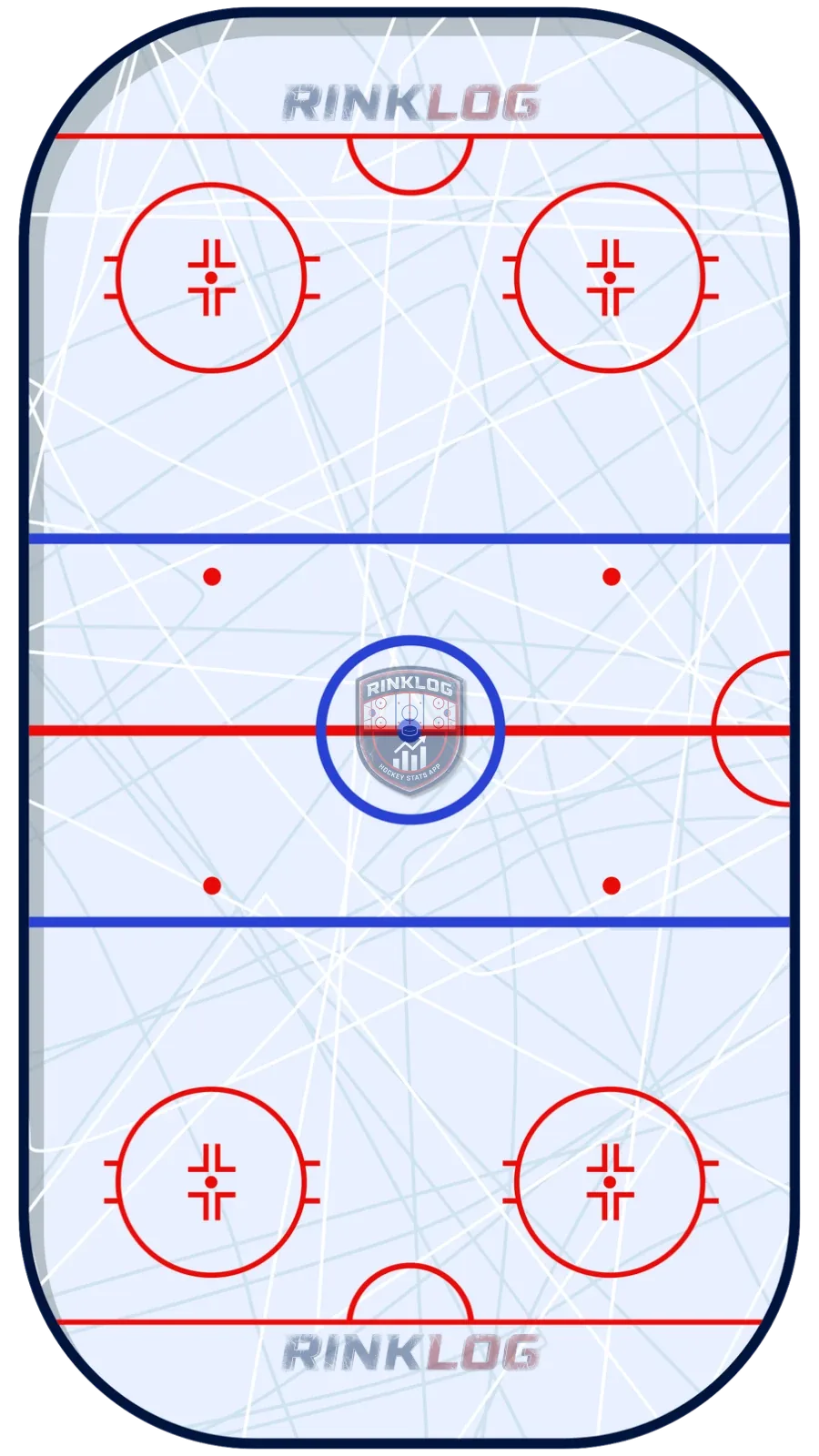
Phase 1 / 4Full ice
Base 2-3 / Left-Lane Lock shape: F1 engaged on O1, F2 high on the strong side, LD1 at center, RD2 at the strong-side blue line. F3, the left wing, stays low on the left, the locked lane, no matter where the puck goes.
- Our team
- Opponents
- Pass
- Shot
- Puck
F1 and F2 press relentlessly on the opposing defensemen and every pass they try to make, skating constantly, finishing their checks and retreating fast. The harder they work, the more effective the system becomes: their discipline carries the entire weight of the 2-3.
The lock's role, traditionally the left wing because left wings are historically stronger defensively while right wings do the scoring, has to be clearly assigned in advance. Without a clear assignment, the read creates confusion: sometimes nobody covers the spot, sometimes two players do at once, sometimes one arrives too late. His discipline, staying low and not jumping up too early, is exactly what shuts down breakouts on the left. Once the puck is recovered he can jump up offensively, but has to drop back the moment there is any doubt or a new turnover. The system therefore looks a lot like the Swedish torpedo, except it relies on a single forward committed deep at all times instead of two.
Against a direct breakout up the wall, the wide-side forward drops down to close on the first receiver, forcing a relay to the middle. The central defenseman then pinches quickly on that pass while the other defenseman fills his spot and the lock fills wide at his own side's blue line: a three-level coverage chain typical of the system.
The lock is not always passive: against a cross-ice pass coming back toward his own lane, he is the one who finishes the check on the winger while the strong-side defenseman fills the blue line behind him. Against a carrier circling the net, the lock closes the pass along the boards once the other forward has blocked the full loop. Against a reversal, it is instead the central defenseman, usually fixed in the middle, who steps out to cut the strong-side boards, an unusual amount of flexibility for that spot.
The documented weakness: a breakout well executed through the right side or the middle, where the 2-3's pressure stays noticeably lighter than on the locked left lane. The most common mistake stays an undesignated lock, or a player jumping up too early after a turnover that is still uncertain.
One detail is enough to recognize a real 2-3 from the stands: the lock is the same player, shift after shift, never improvised on the fly based on whoever happens to be closest when the turnover comes. RinkLog timestamps forced clears on the locked side versus the open side, a good indicator for judging, over a full game, whether the chosen lane is really the right one for that particular opponent.
- The lock has to be assigned in advance, never improvised
- F1 and F2 carry the system through constant work
- Three-level coverage chain: the defenseman pinches, the other fills, the lock fills even wider
- Known weakness: a breakout through the right side or the middle, pressed less hard
RinkLog measures and computes all of this automatically during your hockey, ball hockey and ringette games.
No credit card required. The free plan stays free.
Frequently asked questions
Why is the left wing almost always chosen as the lock?
Because left wings are historically stronger defensively, while right wings tend to be the team's scorers. It is not an absolute rule: some teams instead assign their best defensive-minded winger to that spot.
What is the difference between the left wing lock and the torpedo?
The left wing lock keeps a single forward deep at all times while one player locks a specific lane. The torpedo commits two forwards deep at once, which demands a center able to defend like a defenseman.
The free plan lets you create a player and track their games with no credit card.
Create my free accountOn the same topic
- What are the hockey forechecking systems?Hockey forechecking systems explained: the 1-2-2, 2-1-2, left wing lock, torpedo and control forecheck, with strengths, weaknesses and counters.
- What is the torpedo system in hockey?The torpedo system in hockey: two forwards buzz corner to corner, one safety defenseman, and a center who has to defend like a defenseman when needed.
- What is the 2-1-2 forecheck?The 2-1-2 forecheck, popularized by the 1980s Oilers: two forwards deep, one player high between the defensemen, coordinated defenseman pinches.