
No credit card required. The free plan stays free.
On this page
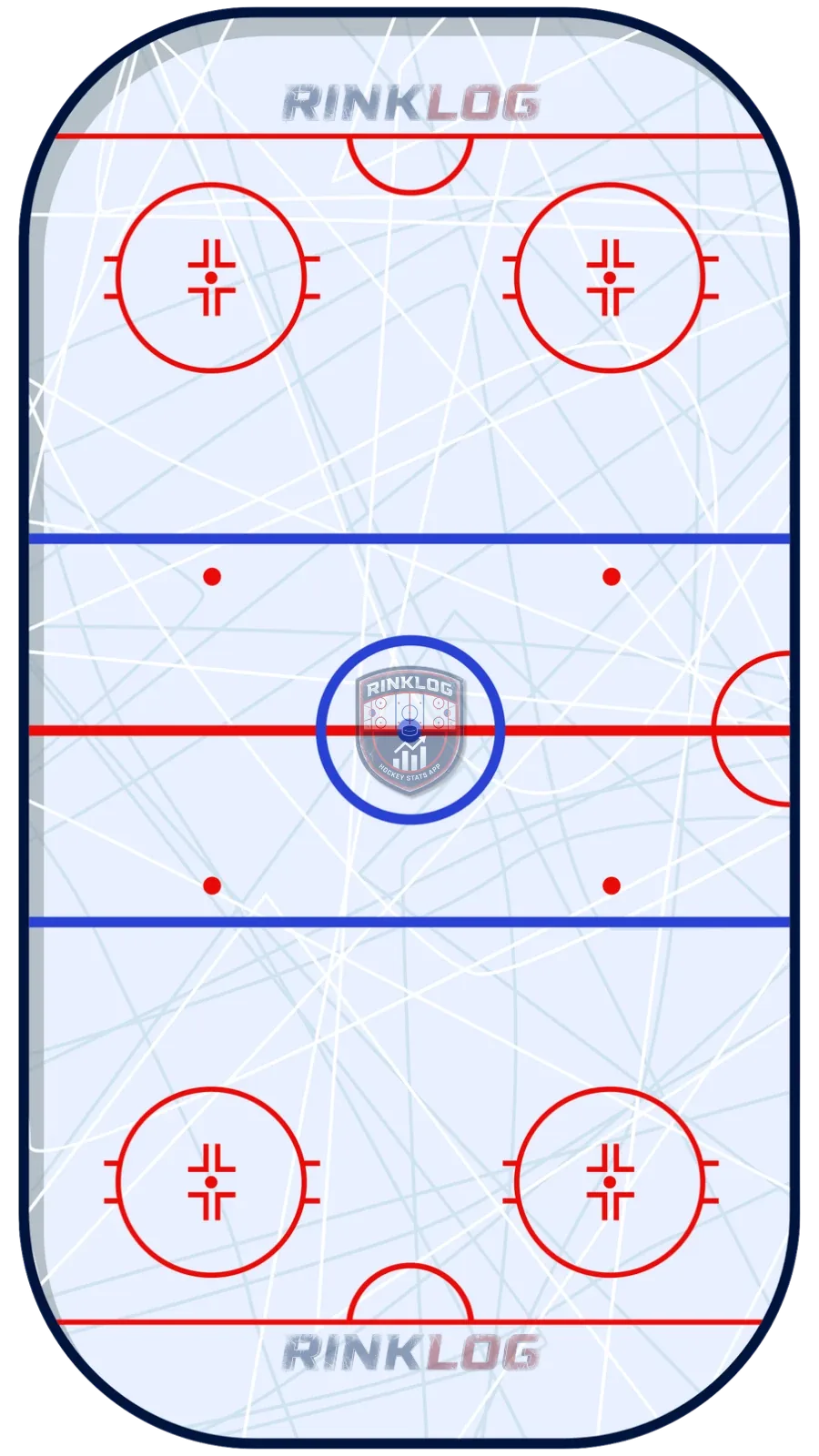
Phase 1 / 4Offensive zone
F1 recovers a low rebound in the corner. D1 and D2 hold both points while F2 stands high in the slot, in front of the net, and F3 occupies mid-slot. X1, the strong-side defensive winger, stays collapsed low with the rest of his team; X2 holds the middle of the slot to mark F3 man to man.
- Our team
- Opponents
- Pass
- Shot
- Puck
Against a defense that collapses all five players low in the offensive zone, the collapsing style, breaking through in front of the net gets hard without first stretching the coverage. The low-high play, shown above, answers exactly that problem: instead of continuing to play only low against a defense already outnumbering the attack there, the offense pulls the defensive wingers out of the scoring area by forcing them to sprint up and cover the point.
A player in low possession, often after collecting a rebound, makes a quick pass up to the point. The defenseman receiving it has three reads: shoot directly through traffic, with forwards screening in front of the net, transfer it laterally to his partner, or feed it back to one of the forwards. If he relays it laterally, the puck travels along the blue line and forces the defensive wingers to react and sprint up to cover the new carrier. That repeated low-high-low sequence opens up space in the slot every time the wingers have to scramble back up.
This play has to be identified before the game, as part of the game plan, the moment a low-collapsing opponent is expected. The point shot through traffic stays a legitimate scoring option in its own right, not just an excuse to stretch the zone; a defense that accepts giving it up, poorly screened or contested, actually limits how effective the stretch becomes.
Activating a defenseman into the offensive zone completes the low-high play, but stays a risk-management decision governed by four rules. Only one defenseman engages deep at a time. Score and time left dictate caution, especially late in a period or with a lead. Forwards need quality possession first, a precondition rather than an option if it is shaky. And if the defenseman comes up without receiving a pass, he cannot linger: a fast, direct return to the blue line the moment the play flips from attack to backcheck.
Three plays give that climb its shape. The strong-side slide exchanges the puck between the forward cycling out of the corner and the defenseman gliding down the same wall, a protective, football-style handoff rather than a pass into open ice; once he has it, the defenseman drives to the net or cuts behind it looking for a pass. Midseam penetration instead cuts through the middle of the slot to surprise a defense overplaying the boards, and only works if the forward first freezes the defender covering him by looking toward the point before the real pass goes out. The back-side slide, the riskiest of the three, sends a long diagonal pass to the defenseman on the opposite side, who drops in deep while the opposing defense is still stacked on the strong side; without a clean reception, that defenseman turns right back rather than lingering low.
Only one thing tells apart a team that truly stretches the zone from one just playing a bit higher by chance: how fast the opposing defensive wingers have to sprint up to the point. That detail, almost invisible from the stands unless you know to look for it, becomes obvious once you know when to watch during the D-to-D pass. Over a full season, it is inside RinkLog that this volume of point shots, on goal or blocked, ends up telling a real stretch play apart from mere puck circulation.
- Against a low-collapsing defense, stretching the zone forces wingers out to the point
- The defenseman at the point reads three options: shoot, transfer, or feed it back to forwards
- Only one defenseman engages deep at a time, never two together
- Without a clean reception on a slide, the defenseman turns right back immediately
RinkLog measures and computes all of this automatically during your hockey, ball hockey and ringette games.
No credit card required. The free plan stays free.
Frequently asked questions
Why does the low-high play work against a low-collapsing defense?
Because continuing to play only low against a defense already outnumbering the attack there goes nowhere. The pass to the point forces defensive wingers to sprint up and cover a new carrier, opening the low slot a little more each time it repeats.
What are the four rules for activating a defenseman in the offensive zone?
Only one defenseman engages deep at a time; score and time left dictate caution; forwards need quality possession first; and without receiving a pass, the defenseman returns immediately to the blue line the moment the play flips to a backcheck.
What is the riskiest activated-defenseman variant?
The back-side slide, which sends a long diagonal pass to the defenseman on the opposite side while he drops in deep. The distance of the pass and the number of players who can cut it off along the way make it the riskiest of the three.
The free plan lets you create a player and track their games with no credit card.
Create my free accountOn the same topic
- How does offensive cycling work in hockey?How offensive cycling works in hockey: boards cycling, the net cycle, and the two exits for a carrier trapped behind the opponent's net.
- What are the main hockey systems?The main families of hockey systems: breakouts, forechecks, neutral zone, attack zone, defensive coverage, special teams and face-offs, explained simply.
- What are the hockey defensive zone coverage systems?The four defensive zone coverage systems in hockey: the 2-3, the low zone collapse, the half-ice overload and man-on-man, compared side by side.