
No credit card required. The free plan stays free.
On this page
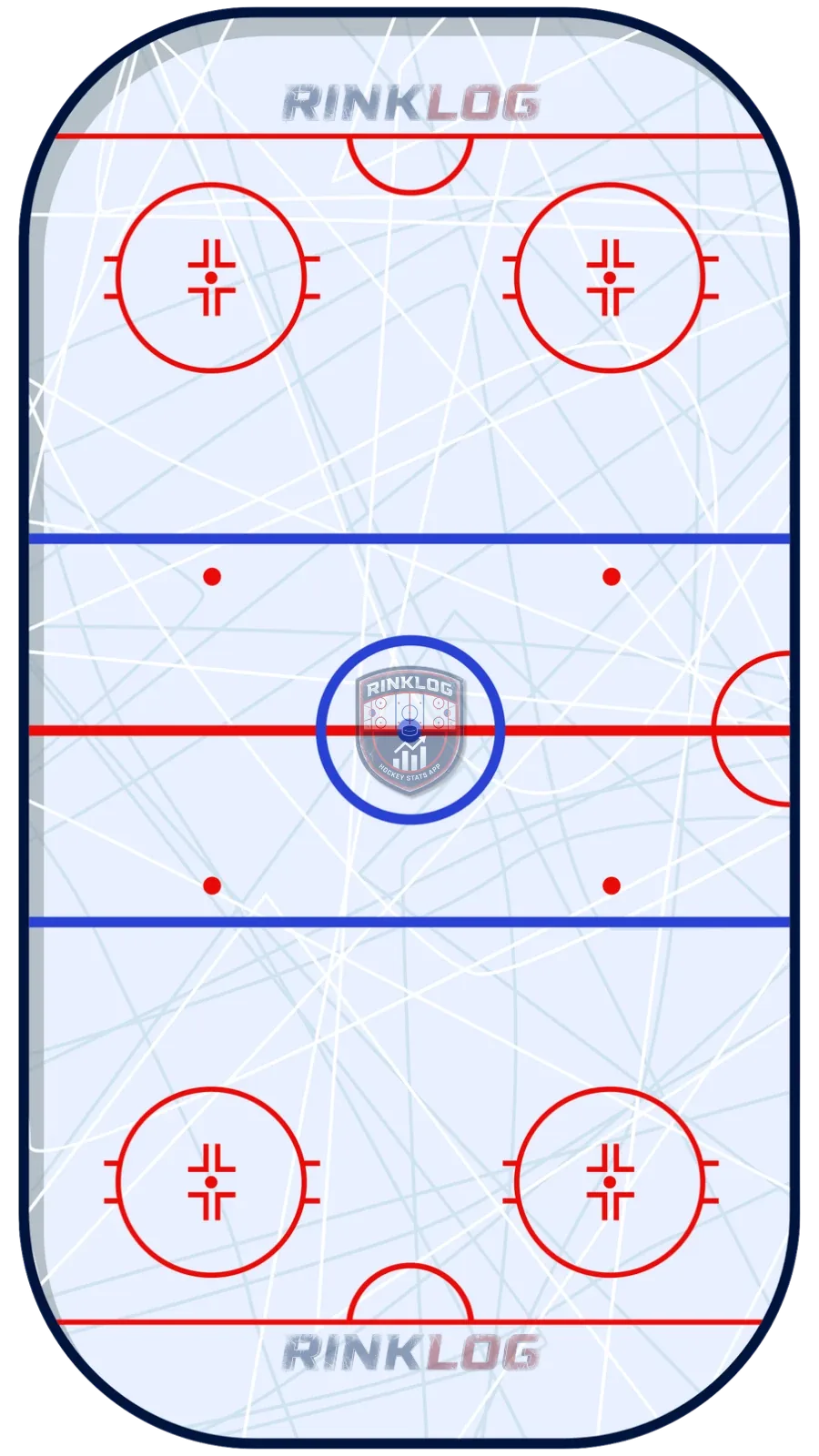
Phase 1 / 4Offensive zone
F1 carries the puck up along the boards toward the blue line while X1 comes to pressure him against the wall. F2 waits just behind him on the same wall, only a step deeper toward the goal line (roughly 3 to 4.5 meters). F3 stays higher up, ready to fill the slot or the high zone.
- Our team
- Opponents
- Pass
- Shot
- Puck
Before even talking about cycling, the book lays out three principles for creating a scoring chance in the offensive zone. Shoot through traffic first: a player planted in front of the goalie takes away his view of the puck, and an unscreened shot becomes a gift against a modern goaltender. Create separation next: players without the puck have to detach from their coverage instead of skating into their checker's back and neutralizing themselves. Create deception last, with the triple-threat position as the simplest tool, the puck held ready to pass, shoot or deke without ever tipping off which of the three is coming.
Boards cycling, shown above, stays the base play to master before any more advanced variant. The carrier moves the puck toward the blue line; under pressure from a defenseman, he angles it off the boards, never into open ice, just far enough from his stick that it bounces onto the blade of a teammate stationed behind him, 3 to 4.5 meters closer to the goal line. That teammate relays to a third player who has slid into the slot during the sequence: the three forwards rotate in a loop, boards, slot, corner. As soon as that first pass connects, the team looks right away for the net instead of cycling out of habit, which often catches a goalie who is not yet set.
The net cycle instead uses the space behind the goal to disorganize the coverage, a play best used when no other option is open: the defense never goes there in numbers, so the attack almost always finds support. The carrier skates behind the net, then, under pressure, feeds the puck to a teammate who has dropped down to support on the other side. The goalie, forced to follow the play behind his back, loses precious time resetting up front, while a third player slides into the slot to become the shooting option. The classic gap: two defensemen who both converge on the net to cover the carrier leave at least one attacker completely alone in front of the goal.
A carrier trapped behind the opponent's net never has to panic: both exits stay available depending on the angle the defenseman uses to attack him. If the defenseman attacks one specific side, option A exits the other way, to a player in a high-probability scoring area, completely open since the defenseman just vacated that zone. Option B, the back door, instead reverses the play like a half-boards cycle, to a teammate filling the space just vacated behind the net, a move that looks almost identical to a cycle pass to fool the defensive read.
The number one mistake inexperienced players make stays the same across both forms of cycling: passing into open ice instead of playing the boards, or cycling out of habit even when a lane to the net is already open. A defense that presses hard and cuts the boards off effectively forces the carrier back to the corner more often, which slows the attack down, the real reason the net cycle exists as a fallback rather than a first choice.
In a real game, the cycle pass should always land on the boards, never in open ice: one glance at the angle of the pass is enough to tell a team cycling correctly from one improvising. When the boards keep closing off, the next logical step is stretching the coverage toward the point instead of forcing it, exactly what low-high plays are for. Every cycle, its pass and its outcome, a shot on goal or a turnover, end up in RinkLog once the sequence wraps up, ready to compare from one game to the next.
- Three principles come first: traffic in front of the goalie, active separation, deception through triple threat
- The cycle pass always plays off the boards, never into open ice
- The net cycle exploits a space the defense never enters in numbers
- Behind the opponent's net, both exits stay available depending on the defenseman's angle of attack
RinkLog measures and computes all of this automatically during your hockey, ball hockey and ringette games.
No credit card required. The free plan stays free.
Frequently asked questions
Why does the cycle pass have to hit the boards?
Because passing into open ice instead of playing the boards is flagged as the number one mistake inexperienced players make, the book puts it bluntly: cycling simply does not work that way.
When should you use the net cycle instead of the boards cycle?
When a defense presses hard and cuts the boards off effectively, forcing the carrier back to the corner too often. The area behind the net stays the one spot where the attack always arrives first, since the defense never goes there in numbers.
What should a carrier trapped behind the opponent's net do?
Stay calm: both exits stay open depending on which side the defenseman attacks from. Exit the opposite way when a high-probability area opens up, or reverse through the back door into the space the defenseman just vacated.
The free plan lets you create a player and track their games with no credit card.
Create my free accountOn the same topic
- How does the low-high play work in hockey?How the low-high play works in hockey against a collapsed defense: point passes, the strong-side slide and activating a defenseman.
- How do you execute a zone entry in hockey?How to execute a clean zone entry in hockey: cross-ice dumps, chips, wide-lane drives, mid-ice entries and the funnel in front of the net.
- What are the main hockey systems?The main families of hockey systems: breakouts, forechecks, neutral zone, attack zone, defensive coverage, special teams and face-offs, explained simply.