
No credit card required. The free plan stays free.
On this page
Phase 1 / 3Offensive zone
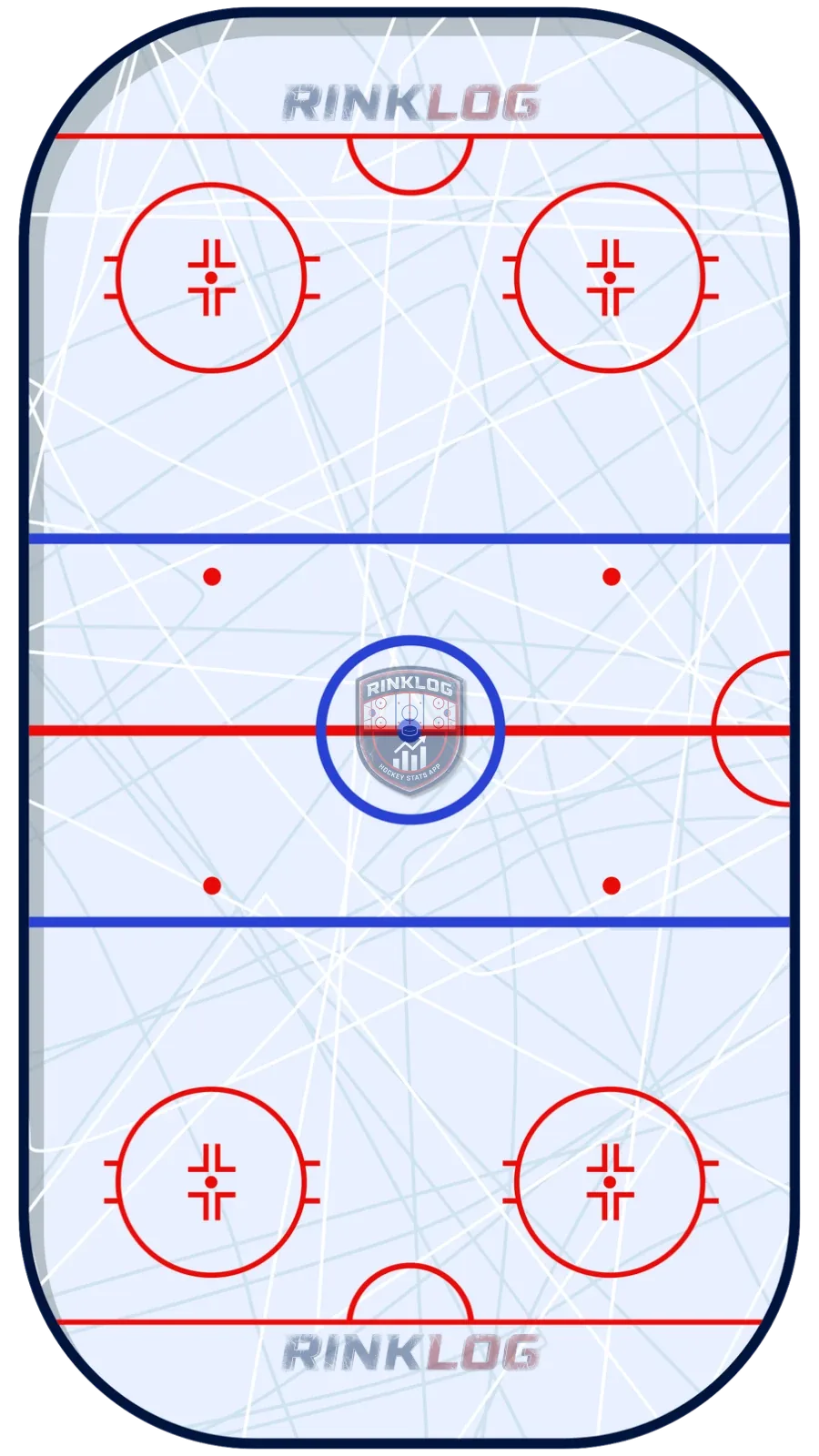
F1 carries the puck across the top of the offensive circles: once he crosses that line, only one option stays open. F2 arrives from the other side with X1 tight on him, while F3 is already heading for the net on the strong side.
- Our team
- Opponents
- Pass
- Shot
- Puck
Puck possession is a basic principle, not just an outcome to chase. Walter and Johnston are specific about the worst case: it is never missing a scoring chance, it is losing the puck carelessly in the band 2 to 2.4 meters before or after the offensive blue line. Right there, the two wingers of the team that just lost it often end up flat along the line, without speed, which opens the door to an odd-man rush the other way. A carrier entering wide into the offensive zone always has to read the gap against the defenseman before picking a tool.
Two dump-ins protect a chance at repossession instead of simply giving the puck away. The cross-ice dump sends the puck diagonally to the opposite corner, reserved for moments when pressure is read or a teammate is already skating the wide lane to chase it down; it has to hit the boards halfway between the net and the side wall, never straight onto the goalie's glove. The rim instead sends the puck down the same side to a teammate backing into the far corner, a play best saved for goalies who are not mobile: against a quick puck-handling goalie it turns into a turnover almost every time.
The chip is about precise placement, not how hard it is fired. In its basic form the carrier first eases the defenseman slightly off the wall, then bounces the puck just behind him and accelerates to chase it down himself, forcing the defenseman to spin and give chase. The more effective variant chips instead into the space behind the defenseman for a teammate arriving from behind with more speed than the original carrier: that carrier has to keep visualizing that space and recognize who around him has the most speed to attack it.
Entering through the middle with a lateral move exposes the carrier to a big open-ice hit, the kind associated with defensemen like Scott Stevens, which is why most coaches prefer a wide-lane entry instead. A successful version still exists: the carrier cuts diagonally just inside the blue line, which pulls both defensemen to his side, then feeds the puck back into the space he just vacated to a teammate arriving there with more speed. A second option pushes the puck to a stationary outside player, whose reception pulls the coverage back toward the net with every pass, until it finds a low relay behind the net.
The wide-lane drive stays the most used entry, because outside space is usually the space available. The defenseman, wary of speed, protects the middle first before cutting the lane off deeper, which leaves the carrier three reads: cut inside if space opens in front of him, drive deep around if the space is behind, or delay and pivot if the gap closes fast.
Once the top of the offensive circles is crossed, reading stops and execution starts: that is the funnel, shown above, where the carrier has one option, drop the puck low toward the front of the net, while his two teammates drive straight to the net for a rebound instead of trying to get open. Roughly 70 to 80 percent of goals come from exactly that kind of second shot, which is why the best goal scorers are mostly the ones who shoot the most. From the stands, watch which tool a player picks once he crosses the blue line, and what it produces next. That output gets counted in RinkLog once every zone entry is dated and its outcome logged, rather than eyeballed over the course of a game.
- The most dangerous spot: 2 to 2.4 meters on either side of the offensive blue line
- The cross-ice dump has to hit the boards halfway, never straight onto the goalie's glove
- The chip is about placement, not speed: ease the defenseman off the wall first
- Once the top of the circles is crossed, only one option remains: puck to the net
RinkLog measures and computes all of this automatically during your hockey, ball hockey and ringette games.
No credit card required. The free plan stays free.
Frequently asked questions
Why is the offensive blue line so dangerous for a turnover?
Because the two wingers of the team that just lost the puck are often caught flat there, without speed, barely 2 to 2.4 meters before or after the line. A turnover right there almost always hands the opponent an immediate odd-man rush.
What is the difference between the basic chip and chipping to a teammate?
The basic chip serves the carrier himself: he eases the defenseman off, then recovers his own puck. Chipping to a teammate instead targets the space behind the defenseman for a player arriving with more speed than the original carrier, considered the more effective of the two.
What should the carrier do once he crosses the top of the offensive circles?
Only one thing: drop the puck low toward the front of the net, without hunting for a perfect shot or one more pass. Both teammates drive straight to the net for a rebound, because roughly 70 to 80 percent of goals come from exactly that kind of second shot.
The free plan lets you create a player and track their games with no credit card.
Create my free accountOn the same topic
- How do you play an odd-man rush in hockey?Odd-man rush plays in hockey: the two on one, three ways to run a two on two, and four ways to play a three on two, including the high triangle.
- How do you break out of your own zone in hockey?Hockey breakout principles: three pressure levels, roles by position (center, wingers, goalie, defense) and three golden rules for a clean exit.
- How do you defend the rush in hockey?Defending the rush in hockey: reading the odd-man break, the real two on one, the two ways to play it, and why holding the middle is the fallback.
- What are the main hockey systems?The main families of hockey systems: breakouts, forechecks, neutral zone, attack zone, defensive coverage, special teams and face-offs, explained simply.