
No credit card required. The free plan stays free.
On this page
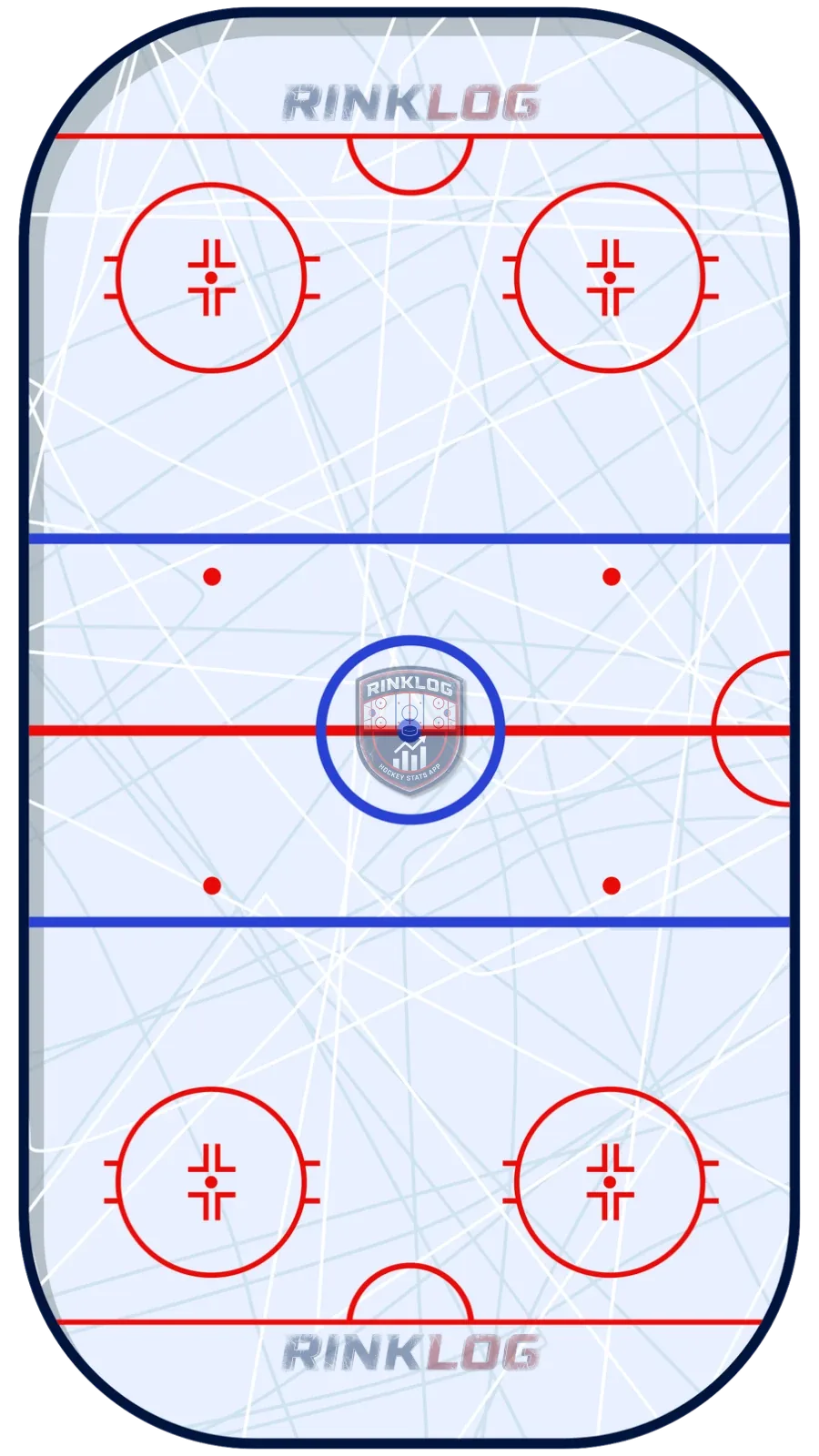
Phase 1 / 3Defensive zone
D1 holds the middle of the ice between the two attackers, no matter whether the rush comes down the middle or the side, and pushes the carrier wide early.
- Our team
- Opponents
- Pass
- Shot
- Puck
The fallback rule for any doubt fits in one sentence: hold position in the middle of the ice, take one extra second to clarify the situation, then move to the outside only once certain. Committing outside too early, before being sure, stays the most common mistake on any zone entry.
The real two on one, shown in the diagram above, pits a single defenseman against two attackers. The rule shared by both ways to play it: hold the middle no matter where the attack comes from, and push the carrier wide early. The first option lets the defenseman cover the player without the puck once the attack reaches the circles, turning to pick up his cover only at the very last moment. The absolute priority: deny the back-door pass, never the carrier's shot, left to the goalie.
The second way to play a two on one relies on timing instead: the defenseman lets himself slide flat on the ice, feet pointed at the net, between the carrier and the player without the puck, taking away the pass option and forcing a shot. Sliding too early or too far lets the carrier cut inside; and once down, the defenseman can no longer react to a rebound, leaving the net open.
A two on two demands a tight gap between both defensemen, roughly two stick lengths, or the defense loses the ability to backpedal at the rush's speed. Two options exist: each defenseman stays with his own man with zero confusion, or the first hands off his cover the moment the carrier crosses to the other side, which keeps each defenseman on his own side but briefly exposes both attackers during the switch.
A three on two adds a variable: correctly telling a true odd-man rush apart from a false three on three, where the backchecker does not yet have real position on his man. As long as that doubt lingers, both defensemen play the situation as a three on two, cautiously, rather than assuming a coverage that does not exist yet.
The read shows up at the blue line: count the attackers, count the defenders, and watch whether the call actually gets shouted out loud. A well-read entry rarely ends in a quality shot. Shots and turnovers, timestamped in RinkLog, then draw the line between a genuinely dangerous chance and harmless possession.
- Fallback rule for any doubt: hold the middle, wait a beat, only move out once certain
- On a two on one, denying the back-door pass is the absolute priority
- A tight gap between both defensemen conditions the entire two on two
- Tell a true odd-man rush apart from a false one by the backchecker's real position
RinkLog measures and computes all of this automatically during your hockey, ball hockey and ringette games.
No credit card required. The free plan stays free.
Frequently asked questions
What is the best way to play a 2 on 1?
The book does not prefer either one: covering the player without the puck by turning at the last moment, or sliding flat at the right time to take away the pass, both work. The choice often depends on how much the defenseman trusts his goalie against the direct shot.
How does a 3 on 2 differ from a 2 on 1?
It adds a third threat and first requires confirming it is a genuine odd-man rush, not a three on three where the backchecker simply has not caught up to his man yet.
Why do coaches insist so much on verbal communication?
Because backchecking forwards read the rush from their own angle, often the reverse of the defensemen's. Without a fast, clear call, two players can end up thinking they cover the same opponent while a third stays completely free.
The free plan lets you create a player and track their games with no credit card.
Create my free accountOn the same topic
- What are the hockey defensive zone coverage systems?The four defensive zone coverage systems in hockey: the 2-3, the low zone collapse, the half-ice overload and man-on-man, compared side by side.
- How does the low zone collapse work in hockey?The low zone collapse in hockey: all five players collapse in front of the net, the D-to-D role swap, and the strengths and weaknesses of the system.
- What is backchecking in hockey?Backchecking in hockey: wide-lane lock, midlane backcheck and hound the puck, compared, with the keys to an effective defensive retreat.
- How do you execute a zone entry in hockey?How to execute a clean zone entry in hockey: cross-ice dumps, chips, wide-lane drives, mid-ice entries and the funnel in front of the net.
- How do you play an odd-man rush in hockey?Odd-man rush plays in hockey: the two on one, three ways to run a two on two, and four ways to play a three on two, including the high triangle.