
No credit card required. The free plan stays free.
On this page
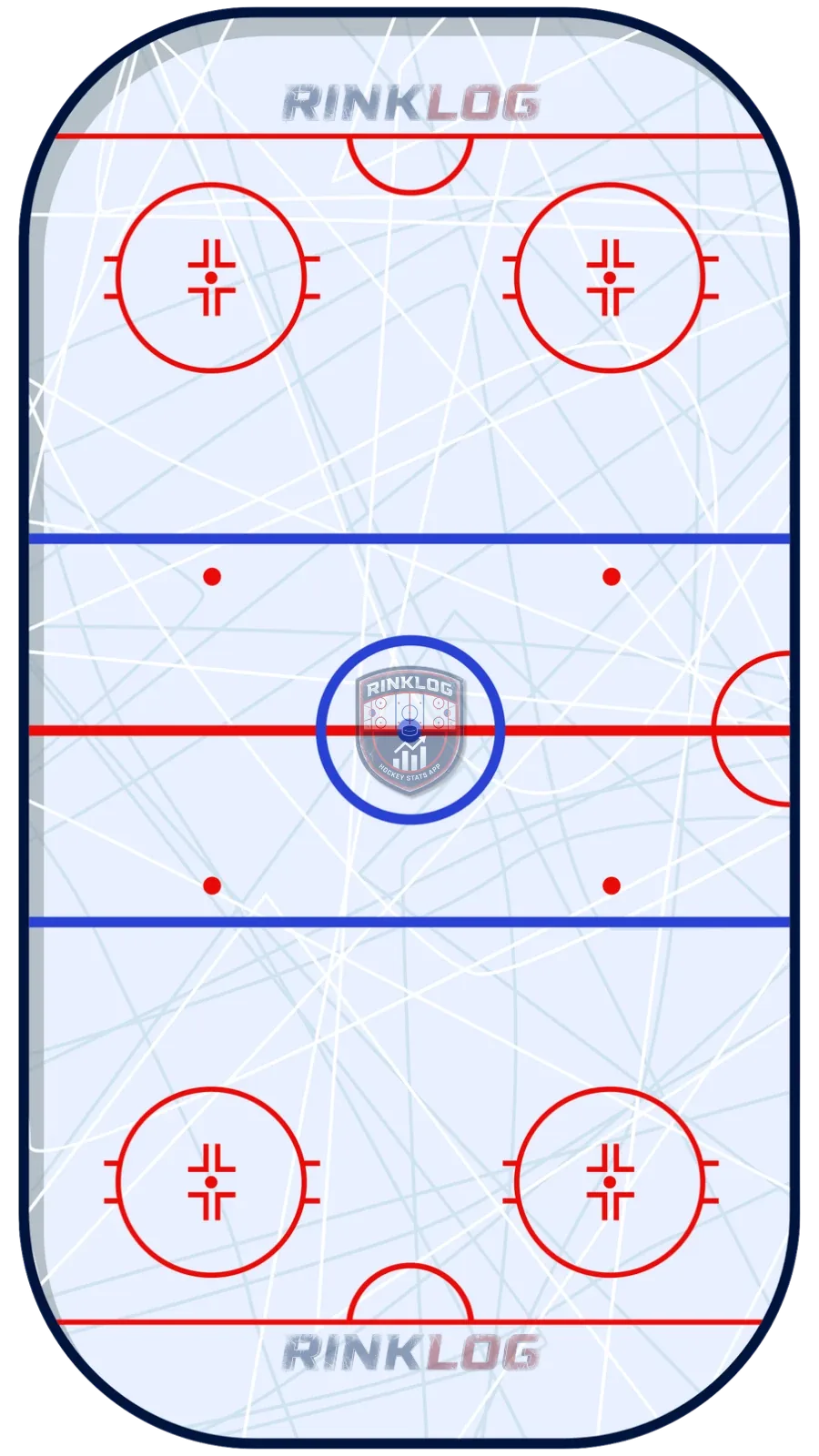
Phase 1 / 3Defensive zone
D1 presses the puck carrier (O1) directly as soon as he receives it. F1 pressures the next receiver, F2 and F3 each stick to an opposing defenseman at the point, and D2 covers the low zone. Zero confusion: everyone knows their man.
- Our team
- Opponents
- Pass
- Shot
- Puck
The sequence always starts with the carrier. One defenseman presses the opposing attacker directly the moment he receives the puck. Once a pass leaves, that same defenseman sticks to his original man wherever he goes to get open: the only exception is a player without the puck, tracked only up to the blue line, a buffer zone that gives a little room while the play is not yet dangerous.
Every spot has its own mandate. A forward pressures the next receiver of the pass, under the same rule: if the puck moves again, he sticks to his man. A second defenseman handles the low zone rather than a specific opponent. The last two forwards each cover an opposing defenseman posted at the point, whether he steps into the slot or slides along the boards.
The system's strength is total clarity: no coverage handoffs, no moment where two players both think they are covering the same opponent, or nobody is. The attack gets very little possession time, and players without the puck struggle to find room for a return pass, since they can never skate away from their shadow.
The weakness is the exact mirror of the strength: the system has no collective safety net like the 2-3 or the low collapse zones provide. A single player losing his cover immediately creates a quality chance, with nobody else there to fill the vacated space. A very mobile attack, with a lot of position swaps, gradually wears the coverage down until it breaks, especially if the defensemen are slower than the attackers they are tracking.
No imaginary colored zones mark up man-to-man: every player literally follows one specific jersey, no matter where the puck moves. Watch a single individual matchup for a full shift instead: the moment a defenseman hesitates between following his man and helping a teammate reveals whether the system is still holding. An individual breakdown, or a real system problem? Shots and chances allowed, timestamped and located in RinkLog, tell the two apart.
- Every player tracks a specific opponent, never a space
- Buffer zone up to the blue line, only for a player without the puck
- No coverage handoffs between teammates
- No collective safety net: a single breakdown opens a chance
RinkLog measures and computes all of this automatically during your hockey, ball hockey and ringette games.
No credit card required. The free plan stays free.
Frequently asked questions
Does man-to-man defense suit minor hockey?
It demands good skaters and strict discipline, which makes it more demanding than a zone system for a team still developing. Individual concepts (support, body position) are taught early, but full man-to-man coverage is worked on once base skills hold up under pressure.
Why does man-to-man leave a buffer zone up to the blue line?
Because tracking a puckless player all the way to the offensive blue line would waste energy on a threat that does not exist yet. The buffer zone keeps him close without exhausting a defender on an opponent far from any real danger.
The free plan lets you create a player and track their games with no credit card.
Create my free accountOn the same topic
- What are the hockey defensive zone coverage systems?The four defensive zone coverage systems in hockey: the 2-3, the low zone collapse, the half-ice overload and man-on-man, compared side by side.
- How does the 2-3 defensive zone system work?The 2-3 defensive zone system: five zones, engagement, support, net, strong-side high and back-side slot, with the most common breakdowns.
- How do you evaluate a hockey player?Evaluating a skater beyond points: production per ice time, on-ice impact (SCF%), shot volume and the season trend.