
No credit card required. The free plan stays free.
On this page
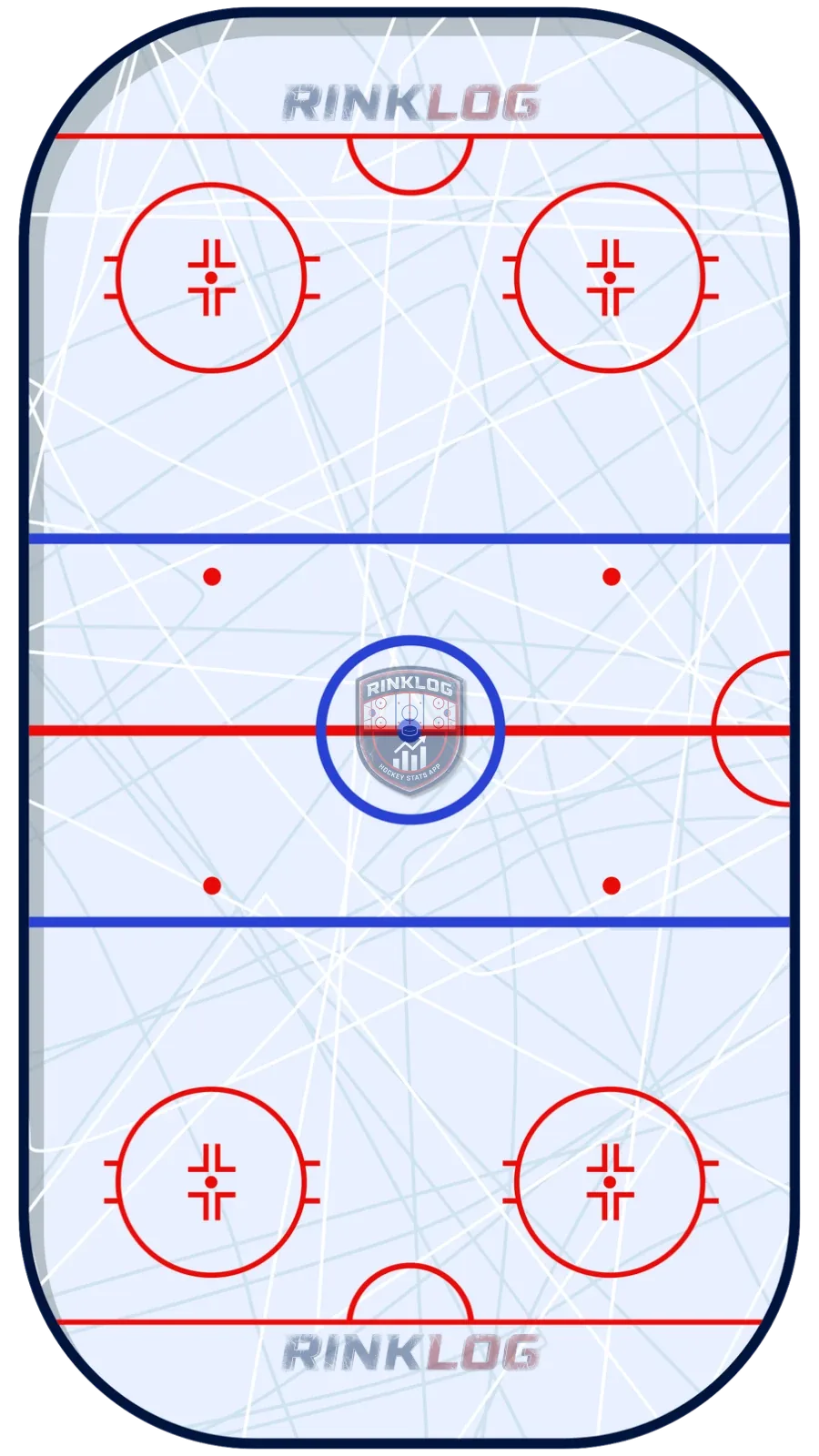
Phase 1 / 5Offensive zone
Goal-line 2-3 setup: D1 and D2 hold the blue line, F1 and F2 sit low on each side, F3 takes the middle in front of the net. Only three killers, in a triangle.
- Our team
- Opponents
- Pass
- Shot
- Puck
One nuance matters before judging: you rarely get the full two minutes, because the first penalty usually expires well before the end. Fans expect a hundred percent conversion, but a unit scoring half the time on sequences that short is already doing remarkable work.
The goal-line 2-3 is the static base: two players on the blue line, three low near the goal line, one of them in the middle in front of the net. Four triggers come out of that same formation. The puck moves D to D and then down to a low player, who either sends it quickly across to his counterpart or feeds the middle man in the slot. The other two options go back up: the low player relays to a defenseman who moves across for a one-timer, or feeds the second defenseman directly.
The motion 2-3 keeps the same base and adds movement, because penalty kills eventually get good at holding their lanes. Two variants exist. In the first, a defenseman fakes a shot then slides flat across the ice while his partner moves in behind him, which opens the shot, the low pass or the return for a one-timer. In the second, a defenseman skates right in front of the net, forcing the coverage to account for a fourth low player.
The umbrella is the third possibility: a high triangle of three shooters plus two players sliding low as a screen and a passing outlet. It makes sense when the team owns the one-timers to make that threat credible. All three triangle players have to stay dangerous on every reception, otherwise the triangle becomes a simple carousel.
The counter is arithmetic and merciless. With three players, the kill has to choose. A tight triangle taking away the slot forces the power play to the outside options. A coverage stepping up on the points frees the low players. No three-man formation covers five positions at once: the power play's job is to move the puck fast enough that the choice becomes visible.
The most common mistake is not tactical but human: sticking to one repeated option, which becomes readable even five on three. While the sequence runs, count the shots and note where they come from. A unit that shoots three times from the point without ever feeding the slot tells you immediately what is missing. With RinkLog every shot and scoring chance is logged with its zone, which makes that read obvious after the game.
- Keep all four options ready: the playmaker picks based on the coverage
- Sticking to one repeated option becomes readable even five on three
- A defenseman sliding flat across desynchronizes the static 2-3 coverage
- A defenseman dropping in front of the net creates an unexpected threat
- Every movement must open a specific passing lane, never motion for its own sake
RinkLog measures and computes all of this automatically during your hockey, ball hockey and ringette games.
No credit card required. The free plan stays free.
Frequently asked questions
Should a five on three always produce a goal?
No. The benchmark taught is roughly one goal in two chances, against roughly two in ten on a regular power play. And since the sequence rarely lasts the full two minutes, a unit hitting that mark is already doing very well.
Which setup should you pick on a five on three?
The one that best suits your players, then work it properly: each of the three already contains enough variety. The goal-line 2-3 spreads more responsibility low, the umbrella concentrates the threat high, and the motion 2-3 is for when the opponent holds its lanes well.
The free plan lets you create a player and track their games with no credit card.
Create my free accountOn the same topic
- How do you play a four on three power play?The four on three in hockey: the two possible setups, box and umbrella, how to choose between them, and the low two on one the box tries to exploit.
- What is the umbrella power play?The umbrella power play explained: a high three-shooter triangle, two low players, the four options from the book, strengths, weaknesses and counters.
- How does a hockey power play work?How a hockey power play works: breakout, zone entry, overload, 1-3-1 and split setups, five on three, four on three, and realistic success rates.