
No credit card required. The free plan stays free.
On this page
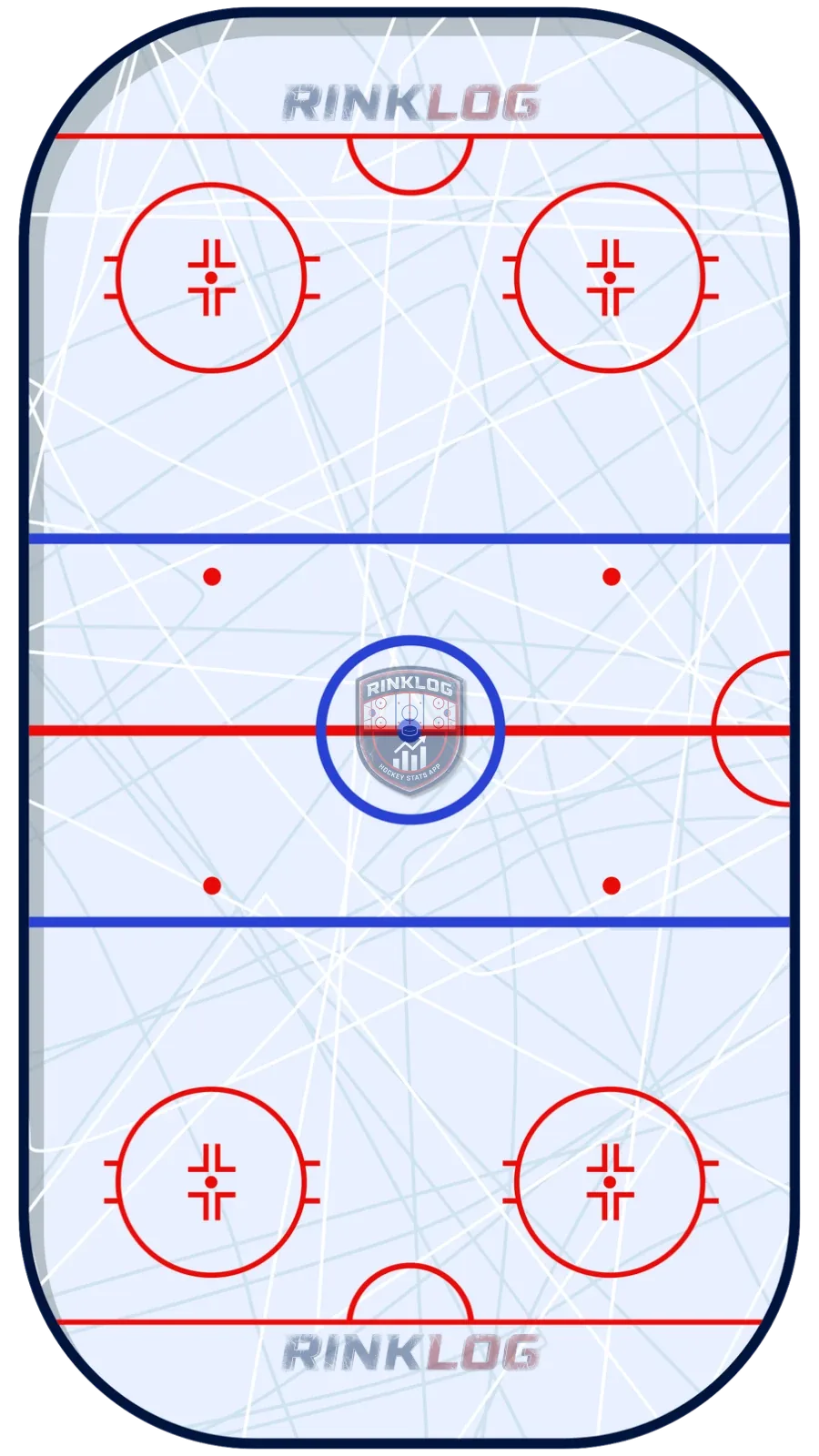
Phase 1 / 5Offensive zone
Four-man umbrella setup: D1 and D2 at the points, F1 at the top of the triangle, F2 alone in front of the net as a permanent screen.
- Our team
- Opponents
- Pass
- Shot
- Puck
The box puts two players high on the blue line and two low in the zone. Both pairs must be opposite handed, a lefty and a righty in each, to cover both angles. Only two options come out of it: the puck moves from high to a low player, who sends it across to his partner for a quick shot, or the two high players relay it back and forth looking for the one-timer.
The appeal of the box rests on a predictable imbalance. The penalty kill almost always overcovers the one-timers from up high, which leaves a two on one for the two low players. The unit's job is to wait for that moment rather than force the shot. One of the two low players still has to be in screening position whenever a high player shoots, otherwise the goalie sees everything and the imbalance buys nothing.
The four-man umbrella keeps the high triangle: two players at the points, a third at the top, and a single player in front of the net as a constant screen. Four options come out of it, very close to the five on three ones: the one-timer from a point after a cross-ice move, the return to the top man, the return to the first point, or the low pass to the net man, who moves it back up or across to the top.
The selection criterion is clear. The umbrella suits teams that own a genuinely heavy one-timer at the top, able to make the threat credible over and over. The box suits teams that can make quick low plays once the point shot is taken away. Without a credible shot at the top, the umbrella loses its main appeal: its single low player cannot generate the superiority the box creates with two.
Against three killers, each setup offers the same dilemma in reverse. Against the box, a coverage that stays on the two low players removes the two on one and forces a shot from up high, less dangerous without a constant screen. Against the umbrella, doubling the lone net man frees one of the three triangle players, while covering the whole triangle leaves that player alone in front of the goalie.
The difference is visible at first glance, even from the top row: two low players means a box; a single player in front of the net with three arced above the circles means an umbrella. Then watch whether the shots are actually screened. With RinkLog, shots and scoring chances are timestamped and located, which lets you check whether the chosen formation really matches the strengths of the team.
- In the box, both high players and both low players must be opposite handed
- A low player must always screen when a high player shoots
- The low two on one is the real reward of the box, not the point shot
- The umbrella only makes sense if the top one-timer is a genuine threat
- One low player in an umbrella never replaces the superiority of the box
RinkLog measures and computes all of this automatically during your hockey, ball hockey and ringette games.
No credit card required. The free plan stays free.
Frequently asked questions
When do you see a four on three?
It is the rarest advantage situation in a game. It shows up mostly when a penalty is called during four-on-four play, or when two penalties partly overlap and one of them has just expired.
Box or umbrella: how do you decide?
Look at your players. If you have a genuinely feared one-timer, the umbrella gives him the best angle and the most touches. Otherwise the box pays better, because it creates a low two on one as soon as the kill focuses on the high threat.
The free plan lets you create a player and track their games with no credit card.
Create my free accountOn the same topic
- How do you score on a five on three power play?The five on three in hockey: why it should produce a goal about half the time, the three possible setups, and the options each one offers.
- What is the umbrella power play?The umbrella power play explained: a high three-shooter triangle, two low players, the four options from the book, strengths, weaknesses and counters.
- How does a hockey power play work?How a hockey power play works: breakout, zone entry, overload, 1-3-1 and split setups, five on three, four on three, and realistic success rates.