No credit card required. The free plan stays free.
On this page
- What does each session really cost?
- At 4 times a week or more, is it worth investing in skates?
- Where should you spend first on hockey gear, and where can you save?
- What is the real difference between entry-level and top-end gear?
- How long does hockey gear last depending on how often you play?
- Can you buy used hockey gear?
- What do Bauer and CCM warranties cover?
- Once, twice, 4 times a week or more: what to buy
- How do you know how many sessions you actually play?
- Frequently asked questions
What does each session really cost?
The price tag alone tells you very little. What matters is the price divided by the number of times the piece gets used before it wears out or gets outgrown. The formula fits on one line: cost per session = price ÷ (sessions per week × weeks per season × seasons of lifespan).
The tool runs the math for skates, sticks and helmets using real prices listed in Canada, then for gloves, shin guards, shoulder pads and pants using the price you see in store. Lifespans are estimates: no manufacturer publishes one, in hours or in seasons.
The math uses cautious assumptions: a 26-week season (roughly October to March), no resale, and sharpening left out because it costs the same whatever the skates. If your child is still growing, lifespan is capped at 2 seasons, the assumption RBC uses in its own estimate of what hockey costs.
What does each session cost?
Pick the piece and the pace: the tool divides the price by the number of sessions it should last.
Cost per session, estimate
- Entry levelCheapest$2.93
$240 to $370 · 1 season, 104 sessions
- Mid-range$3.69
$500 to $650 · 1.5 seasons, 156 sessions
- Top of the line$6.61
$1,300 to $1,450 · 2 seasons, 208 sessions
At 4 sessions a week, entry level costs the least per session ($2.93). The top end works out to $6.61, 2.3 times as much.
- Skates and the helmet are where the money goes first: a poor fit holds back development or causes injuries. Have them fitted in store.
- A stiffer boot keeps its support longer, hence the longer lifespan in our estimates.
Estimated lifespans: no manufacturer publishes one. Senior prices listed in Canada on October 30, 2026, before tax; junior sizes cost less. No resale, no sharpening.
No credit card required. The free plan stays free.
At 4 times a week or more, is it worth investing in skates?
For a player who skates a lot, the argument changes. At once a week, entry-level skates last several seasons and the top end costs close to 3 times as much per session. At 4 times a week, entry level wears out in about a season, and the per-session gap drops below 2 times.
The table runs the same math with named models. Lifespans come from ranges published by retailers and on player forums: 3 to 8 years for a skate used once a week, from under a season to 2 years at 4 times a week or more. These are orders of magnitude, not measurements.
| Frequency | Skate | Price (CAD) | Estimated lifespan | Sessions | Cost per session |
|---|---|---|---|---|---|
| Once a week | Vapor Fly30 (entry) | $369.99 | 4 seasons | 104 | $3.56 |
| Once a week | Vapor FlyLite (top end) | $1,369.99 | 5 seasons | 130 | $10.54 |
| 4 times a week | Vapor Fly30 (entry) | $369.99 | 1 season | 104 | $3.56 |
| 4 times a week | Vapor FlyLite (top end) | $1,369.99 | 2 seasons | 208 | $6.59 |
Swipe the table sideways to see every column.
At 4 times a week, the top end costs about $3 more per session instead of $7, and entry-level skates need replacing every season.
Prices listed on HockeyMonkey.ca on October 30, 2026. 26-week season, no resale. If the FlyLite resold for $300 after 2 seasons, the cost would drop to about $5.14 per session.
Our take for a player on the ice 4 times a week or more: mid-range is the right compromise. In the tool, it works out to about $3.69 per session versus $2.93 for entry level (at the middle of each price range), less than a dollar more for a boot that keeps its support longer and lasts the season. The top end remains a choice of performance and comfort, not of savings.
At 5 sessions a week or more, entry-level skates would wear out before the season ends by the same estimates. Buying a new pair in February also means breaking in skates at the worst possible time.
Where should you spend first on hockey gear, and where can you save?
People in the trade have been giving the same answer for a long time: the money goes first to skates and the helmet. An Ottawa store manager summed it up in 2013: a poor fit on those two pieces holds back a player's development or causes injuries, while families tend to overspend on gloves for the look.
- Spend: skates. Not necessarily the priciest model, but the right size and the right shape, fitted in store. See skate sizing by model.
- Spend: the helmet. New if possible, CSA certified, properly fitted. Used only if you know its history.
- Always new, for hygiene: the mouthguard, the neck guard and the jock or jill.
- Save safely: pants, shin guards, elbow pads and shoulder pads. Used ones are reasonable if they fit and come from a good brand.
- Don't overpay: gloves and sticks. An entry-level stick breaks and wears out like any other; the top end mostly buys lightness.
One nuance comes up among players: very cheap pants protect the tailbone poorly. It is only a forum opinion, but it matches common sense: saving on protective gear, yes; buying protective gear that doesn't protect, no.
What is the real difference between entry-level and top-end gear?
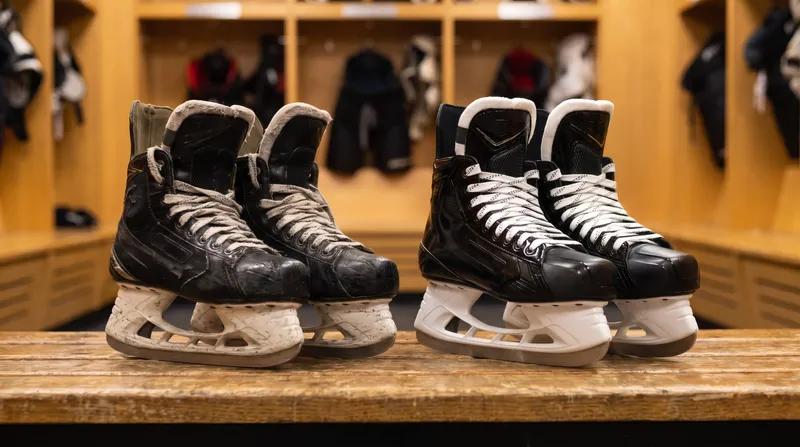
In senior skates, you go from about $240 to $370 CAD at entry level (CCM Jetspeed FT860, Bauer Supreme F20, Vapor Fly30) to $500 to $650 mid-range (CCM Tacks XR 80, Bauer Vapor Fly40), then $1,300 to $1,450 at the top end (CCM Tacks XF Pro, Bauer Vapor FlyLite and Supreme Fuse). In senior sticks, from $110 to $180, then $230 to $300, then $440 to $460. In helmets, from $75 to $200, then $300 to $370, then $400 to $600.
Weight
It is the only measured difference you can compare: a Bauer FlyLite stick weighs 360 g (12.7 oz), versus 440 g (15.5 oz) for a Fly40. A strong player who shoots a lot will feel it. A beginner, far less.
Boot stiffness
Pricier skates have a stiffer boot that holds its support longer, which explains the longer lifespans in our estimates. But no manufacturer publishes a stiffness number: you cannot compare two models on paper. A boot too stiff for a light young player can even keep the ankle from flexing.
Helmet protection
Every helmet sold in Canada for hockey must carry CSA Z262.1 certification. The top end does not pass a tougher standard. In 2015, a Virginia Tech study of 32 helmets even found that price had no effect on performance. Models have changed since: the takeaway is that an expensive helmet is not automatically safer, and a well-fitted helmet beats a pricey one that fits poorly.
How long does hockey gear last depending on how often you play?
No manufacturer publishes a lifespan. The figures below come from retailers, blogs and player forums: read them as orders of magnitude. For the helmet and most protective gear, the condition of the piece decides, never a number of sessions.
| Piece | Once a week | 4 times a week or more | When to replace it |
|---|---|---|---|
| Skates (boot) | 3 to 8 years, about 5 typically | Under a season to 2 years | Softened boot, heel that no longer locks. The steel can be replaced, the boot can't. |
| Composite stick | Several months to a season | A few weeks to 3 months | Breakage, soft or worn blade |
| Helmet | No official lifespan in Canada | Same | Crack, loose or missing padding, a hard hit |
| Shoulder pads | Up to about 10 years with good care | Less (no figure) | Cracked shell, flattened foam |
| Shin guards | No figure | No figure | Cracked shell, misshapen knee cap, broken straps |
| Gloves | No figure | No figure | Holes in the palm, collapsed foam, open seams |
Swipe the table sideways to see every column.
Retailer and forum sources, no manufacturer data. Easton is quoted by a third-party site at 3 to 6 months of regular use for a stick.
For a child, growth almost always comes before wear. That is why the tool caps lifespan at 2 seasons when you pick still growing: at that point, paying more for a boot that would last 5 years makes no sense. Gear sizing is worth checking at the start of every season.
As for the blade, the steel gets replaced several times over a skate's life. Technicians quoted on a forum mention about 20 to 30 sharpenings before replacing the steel; it is a field observation, not a standard. The sharpening guide covers frequency.
Can you buy used hockey gear?
Yes, and it is the best way to save on protective gear. Stores like Play It Again Sports buy game-ready gear and sell used next to new. One Canadian store quoted in the press pays sellers about 30% of the resale price in cash or 40% in store credit, but that is one store's policy. You will also find plenty of listings on Facebook Marketplace and Kijiji, and some associations run equipment swaps before the season. The Montreal Canadiens' Ensemble pour jouer program collects used gear, refurbishes it and gives it away.
No reliable source puts a number on the average used discount versus new: compare case by case.
Never used: a helmet with no history
A hard hit can damage a helmet without any visible sign. If you do not know its past, you do not buy it. One retailer goes as far as saying: used only if it is new in the box, with its tags. In Canada, the CSA sticker must also stay on the helmet and be visible.
Never used: neck guard, mouthguard, jock
A simple matter of hygiene. They are also inexpensive pieces.
Reasonable used: pants, shin guards, elbow pads, shoulder pads
Provided they fit and are in good shape: no cracks in the shell, foam that springs back, solid straps and Velcro.
A CSA helmet does not expire in Canada: the date on the sticker is the year it was made, not an expiry date. The 6.5-year expiry you sometimes read about comes from the American HECC certification, which does not apply here. What retires a helmet is a crack, loose or missing padding, or a hard hit. After a blow to the head, also read the signs of a concussion.
What do Bauer and CCM warranties cover?
A warranty covers a manufacturing defect, never normal wear. It matters when comparing tiers: a $440 stick that snaps on a shot after two months is usually not covered, because the warranty has already run out.
| Piece | Bauer | CCM |
|---|---|---|
| Composite stick | 30 days, one replacement, claim through the retailer; void if used on concrete or asphalt | 30 days, original buyer only |
| Skates | 90 days (steel included) | 90 days |
| Helmet | 1 year | 1 year |
| Protective gear | 90 days | Varies, generally up to 1 year |
Swipe the table sideways to see every column.
Stick 30 days, skates 90 days, helmet 1 year: keep the receipt, and file the claim through the store.
Based on the warranty guides published by HockeyMonkey. Bauer Canada's own page could not be read directly. No 60- or 90-day stick warranty was found at Bauer or CCM.
Once, twice, 4 times a week or more: what to buy
The table sums up our recommendations by piece. Costs per session come from the tool, at the middle of each senior price range, over a 26-week season, for a player who has stopped growing.
| Piece | Once a week | Twice a week | 4 times or more |
|---|---|---|---|
| Skates | Well-fitted entry level (about $2.93 a session, versus $10.58 at the top end) | Entry or mid-range ($2.93 versus $3.69) | Mid-range: entry level only lasts about one season |
| Stick | Entry level, it should last the season | Entry level, plan on a second one | Entry or mid-range, and several sticks a season; the top end buys lightness |
| Helmet | New, CSA certified, well fitted, whatever the tier | Same | Same |
| Neck guard, jock, mouthguard | Always new | Always new | Always new |
| Pants, shin guards, elbow pads, shoulder pads | Used, in good shape | Used, in good shape | New or used, checked every season: wear comes faster |
| Gloves | Entry level that fits | Entry level that fits | Mid-range if the palms wear quickly; never for the look |
Swipe the table sideways to see every column.
The more you skate, the narrower the per-session price gap, but entry level stays the cheapest per session in our estimates.
How do you know how many sessions you actually play?
The math is only as good as the number of sessions you put in. Many parents over- or underestimate the season: between games, practices, tournaments and open hockey, the real count often surprises. Log every game in RinkLog for a season and you will have your true pace, with ice time as a bonus. That number, not a hunch, tells you whether a $600 skate is worth it next year.
And if the question is rather what the whole season costs, registration, tournaments and sharpening included, our guide to the cost of a hockey season builds the budget by level. For a first purchase, the beginner equipment list says what to buy, in which order.
No credit card required. The free plan stays free.
The best gear investment is the piece that fits and gets used often. Count your sessions in RinkLog this season: next year, you will buy at the right level.
No credit card required. The free plan stays free.
Frequently asked questions
Do expensive hockey skates last longer?
Somewhat, according to retailer ranges: a stiffer boot keeps its support longer. In our estimates, top-end skates last about 2 seasons at 4 times a week, versus 1 for entry level. But since they cost 4 to 5 times as much, they still come out more expensive per session. For a growing child, the question barely comes up: they change sizes before wearing skates out.
Is a $400 hockey stick worth it?
For most players, no. No source shows that a top-end stick lasts longer, and its warranty is only 30 days at both Bauer and CCM. What it buys is lightness: 360 g (12.7 oz) for a Bauer FlyLite versus 440 g (15.5 oz) for a Fly40. At 4 times a week, a stick wears out in a few weeks to 3 months: two $170 sticks beat a single $440 one.
Does a more expensive helmet protect better?
Not automatically. In Canada, every hockey helmet must carry the same CSA Z262.1 certification, and a 2015 Virginia Tech study found no link between price and performance. What matters first is fit: a well-fitted helmet, new or with a known history, with its CSA sticker visible.
What hockey gear should you never buy used?
A helmet whose history you do not know, because a hit can damage it without visible signs, and any helmet without a visible CSA sticker. The neck guard, mouthguard and jock or jill, for hygiene. Pants, shin guards, elbow pads and shoulder pads, on the other hand, are fine to buy used if they fit.
How long do hockey skates last?
No manufacturer publishes it. Retailer and forum ranges give 3 to 8 years, about 5 typically, at once a week, and from under a season to 2 years at 4 times a week or more. You replace skates when the boot has softened and no longer supports the ankle; the steel itself can be replaced.
Does the warranty cover a broken stick?
Only within 30 days of purchase, and only for a defect, at both Bauer and CCM. Bauer grants a single replacement, the claim goes through the retailer, and the warranty is void if the stick was used on concrete or asphalt. Keep the receipt.
Do hockey helmets expire in Canada?
No. The date on the CSA sticker is the year it was made, and CSA certification does not expire. The 6.5-year expiry comes from the American HECC certification, required under USA Hockey only. You replace a helmet that is cracked, whose padding is loose or missing, or that took a hard hit.
References
Every number on this page comes from one of these sources. The links lead to the original text.
HockeyMonkey.ca
Hockey skates, senior composite sticks and helmets (prix affichés)
hockeymonkey.ca, pages de catégories, consultées le 30 octobre 2026
Source of the skate (Fly30, FlyLite, Tacks XR 70 and XR 80, Jetspeed FT860), stick and helmet prices quoted on the page and in the tool.
Read itBauer Hockey et CCM Hockey
Bâtons de hockey, catalogues canadiens
ca.bauer.com et ca.ccmhockey.com, consultés le 30 octobre 2026
Regular stick prices by tier in Canadian dollars (entry $109.99 to $179.99, mid $229.99 to $299.99, top end $439.99 to $459.99).
Read itHockeyMonkey
Bauer Warranty Guide ; CCM Warranty Information
hockeymonkey.com/learn
Bauer and CCM warranty periods (stick 30 days, skates 90 days, helmet 1 year) and their conditions.
Read itHockey Canada
Reminder Regarding Hockey Helmet Certification and BNQ-Certified Neck Protectors
cdn.hockeycanada.ca (PDF)
CSA-certified helmet and face protector required (rule 3.6 b), BNQ neck guard required in minor hockey (rule 3.6 f), no expiry on CSA certification, sticker must be visible.
Read itHockeyMonkey
When to replace a hockey helmet
hockeymonkey.com/learn
Used helmet only if new in box, replacement signs, 6.5-year HECC lifespan in the United States.
Read itOttawa Insight (Université Carleton) (2013)
Entrevue avec Ralph MacLean, Valiquette's Source for Sports
cusjc.ca/ottawainsight
Skates and helmet first; families overspend on gloves.
Read itCBC News
Most hockey helmets fail new safety evaluation proposed by Virginia Tech study
cbc.ca
The 2015 STAR study of 32 helmets: price had no effect on performance. Older models, read it as a principle.
Read itRBC Banque Royale (2024)
Briser la glace : les coûts à assumer pour élever un joueur de hockey au Canada
rbcroyalbank.com
Assumption of gear kept 2 years, used as the lifespan cap for a growing child.
Read itHFBoards, Played On Ice, Icehockeyman
Durée de vie des patins, bâtons et protections (fils et articles)
forums.hfboards.com, playedonice.com, icehockeyman.com
Lifespan ranges by frequency. Retailer and forum sources, presented as orders of magnitude.
Read it
The free plan lets you create a player and track their games with no credit card.
Create my free accountOn the same topic
- Hockey skate size chart: size, fit and the real differences between modelsFind your hockey skate size from your foot in cm or inches, decode Bauer Fit 1, 2, 3 and CCM fits, and compare Vapor, Supreme, Jetspeed and Tacks.
- Skate sharpening explained: radius of hollow, profiling and how oftenPick your skate hollow by weight in lb and kg, see what 1/2 vs 5/8 really changes, learn what profiling does and how often to sharpen, in hours of ice time.
- How much does a season of youth hockey cost in Quebec?Youth hockey registration fees by age group, AA and AAA extras, tournaments, sharpening, gear and financial help: the real budget of a season in Quebec.
- Beginner hockey equipment list: what to buy, in what order, at what priceThe 12 pieces of beginner hockey gear in the order you put them on, what is mandatory, what a first set costs, and what you can safely buy used.
- Hockey equipment size chart: how to find the right size for every pieceHockey equipment sizing piece by piece: helmet, shoulder pads, elbow pads, gloves, pants and shin guards. One measurement per piece, charts and a free tool.