No credit card required. The free plan stays free.
On this page
- What gear do you need to start hockey? The list, in order
- What hockey equipment is mandatory?
- How much does a beginner hockey equipment set cost?
- What can you buy used, and what has to be new?
- Kids or adult hockey gear: what changes?
- What hockey gear can you borrow to get started?
- Frequently asked questions
What gear do you need to start hockey? The list, in order
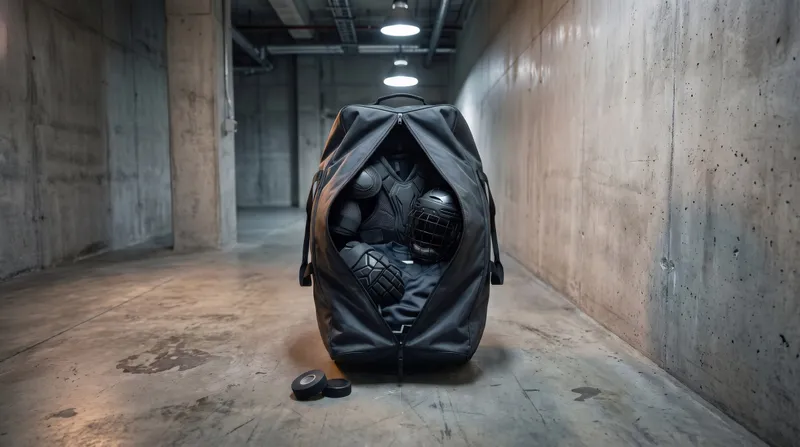
Here are the 12 pieces in the order you put them on, from the body outward. Every player tweaks the order a little (some lace their skates last), but the principle stays the same: what slides underneath goes on before what covers it. Check them off as you pack the first bag.
Step 1: Base layer and jock or jill
A breathable base layer, then the jock or jill, sized by waist measurement. It should fit like briefs, neither loose nor too tight. Always new, for hygiene.
Step 2: Shin guards
Knee centred in the knee cap, the bottom of the guard reaching the top of the skate. Easy to find used.
Step 3: Hockey socks
Over the shin guards, held up by the tabs on the jock or base layer. A strip of tape around the shin keeps everything in place.
Step 4: Pants
Sized by waist measurement. They should overlap the top of the shin guards and protect the tailbone. A reasonable used buy.
Step 5: Skates
The piece to spend on: well fitted, tried on in store with hockey socks. Never too big for a child to grow into.
Step 6: Neck guard
BNQ certified, mandatory in minor hockey. It covers the throat completely; the bib style is worn under the shoulder pads. Always new.
Step 7: Shoulder pads
Sized by chest measurement, taken just below the armpits. A reasonable used buy.
Step 8: Elbow pads
Elbow centred in the cap, with no gap between the pad and the glove. A reasonable used buy.
Step 9: Jersey
Over the shoulder and elbow pads. Some associations include it in registration: in Boisbriand and Sainte-Thérèse, 2 jerseys come with Junior registration.
Step 10: Helmet with cage
CSA certified, with a CSA-certified face protector, unaltered. New, or used only if you know its full history.
Step 11: Gloves
Fingertips near the end of the glove, the cuff meeting the elbow pad. No need to pay for the look.
Step 12: Stick
On skates, it reaches just under the chin. An entry-level model is plenty to start.
Add stick tape, a mouthguard if your association requires one (always new), a water bottle and, for the youngest, blade guards for the walk to the ice. Sizes for every piece are in our guide to hockey equipment sizing.
What hockey equipment is mandatory?
Two pieces are spelled out in Hockey Canada's rules, and Quebec regulations point the same way.
- A CSA-certified helmet and cage (Hockey Canada rule 3.6 b): every player, goalies included, wears a CSA-certified helmet with a CSA-certified face protector attached, unaltered. The CSA sticker must stay on the helmet and be visible.
- A BNQ-certified neck guard (rule 3.6 f): mandatory for players registered in minor hockey and female hockey.
- In Quebec, regulations require a helmet meeting CAN/CSA-Z262.1, a full face protector meeting CAN/CSA-Z262.2 and a neck guard meeting NQ 9415-370 whenever the rink is booked for hockey. They do not cover public skating.
The rest of the gear does not appear as mandatory in the rules we checked, the jock or jill included, but it is part of every player's basic equipment. For adults, government and municipal posters present the neck guard as mandatory in Quebec; we could not read the regulation itself to confirm. Check with your league.
Good to know: a CSA helmet does not expire in Canada. The date on the sticker is the year it was made. After a blow to the head, though, you replace it, and watch for the signs of a concussion.
How much does a beginner hockey equipment set cost?
It all depends on age, new versus used, and the tier. Here are the benchmarks we can source.
| Option | Price (CAD) | What it includes |
|---|---|---|
| Première Présence (Hockey Québec, ages 6 to 10) | $299 | Full head-to-toe gear the child keeps, 6 one-hour sessions and insurance |
| New gear, child aged 5 to 8 (RBC) | About $269 a year | New set kept 2 years, Toronto prices before tax |
| First year of gear | $600 to $1,500 | Range quoted by a 2026 article, attributed to a retailer |
| Entry-level skates, stick and helmet, adult | $425 to $750 | Senior skates $240 to $370, stick $110 to $180, helmet $75 to $200; protective gear still to add |
Swipe the table sideways to see every column.
For a first try at age 6 and up, Première Présence at $299 covers both the full set of gear and 6 sessions on the ice.
Skate, stick and helmet prices listed in Canada on October 30, 2026. No reliable price by tier was found for gloves, shin guards, shoulder pads and pants, nor an average used discount.
For the youngest, sticks cost far less: $69.99 to $79.99 for a Tyke or Youth stick at Bauer and CCM, $89.99 to $139.99 for an entry-level junior. To know where the money should go when moving up a tier, read is top-end gear worth it?, which works out the cost per session. And for the whole season, registration and tournaments included, see how much a hockey season costs.
What can you buy used, and what has to be new?
Used gear is the best way to shrink a beginner's bill, as long as you know where to draw the line.
| Piece | New or used | Why |
|---|---|---|
| Helmet | New, or used only with a known history | A hard hit can damage it with no visible sign; a visible CSA sticker is required |
| Neck guard | Always new | Hygiene |
| Jock or jill | Always new | Hygiene |
| Mouthguard | Always new | Hygiene |
| Skates | New if possible, or used ones that fit perfectly | Fit matters more than anything; a worn boot no longer supports the ankle |
| Pants, shin guards, elbow pads, shoulder pads | Used, no problem | Reasonable if they fit and come from a good brand |
| Gloves, stick | New or used | Check the glove palms and the stick blade |
Swipe the table sideways to see every column.
Where to find it: stores like Play It Again Sports, which buy and resell game-ready gear, Facebook Marketplace and Kijiji, and the equipment swaps some associations run before the season. Before buying used, check that no shell is cracked, that the foam springs back and that the straps hold.
Kids or adult hockey gear: what changes?
The list is the same. What changes is the size, the price and how fast you renew it.
Size categories
At Bauer, protective gear goes from Youth (about ages 3 to 9) to Junior (8 to 11), Intermediate (11 to 13 and up), then Senior (14 and up). Every brand splits it a little differently: go by height and weight, not age alone.
A child outgrows before wearing out
That is why used gear makes so much sense for kids, and top-end gear so little. But never buy too big for them to grow into, especially skates: it hurts stability and learning.
The adult beginner
In senior sizes, prices go up: expect $425 to $750 just for entry-level skates, a stick and a helmet. Since size no longer changes, a good pair of skates lasts several seasons: that is where spending makes the most sense.
For skates, the size comes from foot length: our skate sizing tool gives the size and fit by brand. For the stick, see hockey stick sizing.
What hockey gear can you borrow to get started?
Before buying everything, see what can be lent. A child discovering hockey does not need new gear to find out whether they like it.
- Lend well: pants, shin guards, elbow pads, shoulder pads, gloves and a stick from a brother, a cousin or a neighbour, if they are the right size.
- Lend with care: skates, only if they truly fit. A skate that is too big or too worn spoils the learning.
- Do not borrow: a helmet whose history you do not know, the neck guard, the jock or jill, and the mouthguard.
- Programs: Hockey Québec's Première Présence provides all the gear, which the child keeps; the Montreal Canadiens' Ensemble pour jouer program collects used gear, refurbishes it and gives it away.
Once the first season is under way, log the games in RinkLog: first shifts, first shots, first goal. For a beginner, progress from one game to the next motivates more than any new piece of gear.
No credit card required. The free plan stays free.
The first season is played in gear that fits, not in the priciest gear. Log the games in RinkLog: progress is what makes a kid want to come back.
No credit card required. The free plan stays free.
Frequently asked questions
What is the basic hockey equipment for a beginner?
Twelve pieces: jock or jill, shin guards, hockey socks, pants, skates, neck guard, shoulder pads, elbow pads, jersey, helmet with cage, gloves and a stick. Add tape, a water bottle and, if your association requires one, a mouthguard.
Is a neck guard mandatory in hockey?
Yes in minor and female hockey: Hockey Canada rule 3.6 f requires a BNQ-certified neck guard. In Quebec, regulations also require a neck guard meeting NQ 9415-370 whenever the rink is booked for hockey. For adult leagues, check with your league.
How much does full hockey gear cost for a child?
RBC estimates new gear for a child aged 5 to 8 at about $269 a year, kept 2 years. A 2026 article quotes $600 to $1,500 for the first year. For a first try, Hockey Québec's Première Présence provides all the gear plus 6 sessions for $299, for ages 6 to 10.
Can you buy a used hockey helmet?
Only if you know its full history, because a hard hit can damage it with no visible sign, and only if it still carries a visible CSA sticker. When in doubt, buy new: it is one of the two pieces to spend on, along with skates.
In what order do you put on hockey gear?
From the body outward: jock or jill, shin guards, socks, pants, skates, neck guard, shoulder pads, elbow pads, jersey, helmet, gloves. A bib neck guard goes under the shoulder pads. Some players lace their skates last; what matters is that what slides underneath goes on first.
Should you buy gear bigger so a child can grow into it?
No, especially not skates. A skate that is too big hurts stability and learning, and oversized protective gear leaves gaps or shifts at the wrong moment. Buy the right size, and lean on used gear to keep up with growth without breaking the bank.
References
Every number on this page comes from one of these sources. The links lead to the original text.
Hockey Canada
Reminder Regarding Hockey Helmet Certification and BNQ-Certified Neck Protectors
cdn.hockeycanada.ca (PDF)
Rules 3.6 b (CSA helmet and face protector) and 3.6 f (BNQ neck guard in minor and female hockey), visible CSA sticker, no expiry.
Read itGouvernement du Québec
Réglementation au hockey
quebec.ca
CAN/CSA-Z262.1, CAN/CSA-Z262.2 and NQ 9415-370 standards required when the rink is booked for hockey.
Read itHockey Québec
Les inscriptions au programme Première Présence 2026-2027 sont maintenant ouvertes
hockey.qc.ca
$299 for full gear, 6 sessions and insurance, for ages 6 to 10.
Read itRBC Banque Royale (2024)
Briser la glace : les coûts à assumer pour élever un joueur de hockey au Canada
rbcroyalbank.com, 10 juin 2024
New gear for a child aged 5 to 8: about $269 a year, kept 2 years, before tax.
Read itPuck Prose (2026)
The cost of chasing the dream: what families really spend to raise a hockey player
puckprose.com, 11 mars 2026
Range of $600 to $1,500 for the first year of gear, attributed to Elite Level Hockey (second-hand figure).
Read itGillmania
Guides de tailles Bauer (transcription)
gillmania.com
Bauer age, weight and height chart for protective gear (Youth, Junior, Intermediate, Senior).
Read itHockey Canada (copie hébergée par une association)
Hockey Canada Equipment Fitting Guide
cloud.rampinteractive.com (PDF)
Fitting advice: jock by waist size, bib neck guard under the shoulder pads, never buy skates too big. Older document, origin not verified on hockeycanada.ca.
Read itBauer Hockey et CCM Hockey
Bâtons de hockey, catalogues canadiens
ca.bauer.com et ca.ccmhockey.com, consultés le 30 octobre 2026
Tyke, Youth, Junior and Senior stick prices by tier.
Read it
The free plan lets you create a player and track their games with no credit card.
Create my free accountOn the same topic
- Hockey skate size chart: size, fit and the real differences between modelsFind your hockey skate size from your foot in cm or inches, decode Bauer Fit 1, 2, 3 and CCM fits, and compare Vapor, Supreme, Jetspeed and Tacks.
- Skate sharpening explained: radius of hollow, profiling and how oftenPick your skate hollow by weight in lb and kg, see what 1/2 vs 5/8 really changes, learn what profiling does and how often to sharpen, in hours of ice time.
- Is top-of-the-line hockey gear worth it? It depends on how often you skateCost per session of skates, sticks and helmets by tier and by how often you play. Where to spend, where to save, used gear and warranties, with real numbers.
- How much does a season of youth hockey cost in Quebec?Youth hockey registration fees by age group, AA and AAA extras, tournaments, sharpening, gear and financial help: the real budget of a season in Quebec.
- Hockey equipment size chart: how to find the right size for every pieceHockey equipment sizing piece by piece: helmet, shoulder pads, elbow pads, gloves, pants and shin guards. One measurement per piece, charts and a free tool.