No credit card required. The free plan stays free.
On this page
- What size hockey stick do I need for my height?
- Hockey stick size and flex chart by category (2026)
- How to size a hockey stick
- What hockey stick flex should I use for my weight?
- Cutting a hockey stick: how much does the flex change?
- Low, mid or hybrid kick point: which one to choose?
- Which blade curve: P92, P88, P28 or P90TM?
- Left or right hockey stick: how do you know?
- How much does a hockey stick cost in 2026?
- Frequently asked questions
What size hockey stick do I need for my height?
Short answer: length depends on height, flex depends on weight. A 5'10" (178 cm) player takes a senior stick of about 60 inches; a 4'6" (137 cm) child, a junior of about 50 inches. Enter height and weight below: the tool gives the category, the length to cut to, the flex to buy among the ones actually sold in stores, and the real flex once the stick is cut.
The math does what the makers' calculators don't: a stick longer than needed gets cut, and cutting stiffens it. So the tool takes every 2026 Bauer stick that is long enough, cuts it to your length, and keeps the one that lands closest to your target flex.
What size hockey stick?
Enter the player's height and weight. The tool gives the category, the length, the flex to buy and the real flex once the stick is cut.


Category
Intermediate
Length
142 cm
Flex to buy
Target: 50 to 61
In skates, the end of the stick should reach the chin. Measured from the heel of the blade to the end of the shaft.
New stick (Bauer 2026)
Intermediate 55 · 58 in
After cutting
Cut 2 in: about 61
About 3 flex points per inch cut (2.5 to 5 depending on the source): an approximation. The scale printed on the shaft is what counts.
Kick point
Hybrid kick
In between: a good choice when you shoot from everywhere or don't know yet.
Bauer
Vapor or Supreme
CCM
Jetspeed
Warrior
Alpha
True
Project X
A starting point, not a fitting. Brands do not cut their sticks to the same length: check standing up, the stick upright, before cutting.
No credit card required. The free plan stays free.
Hockey stick size and flex chart by category (2026)
Sticks come in five categories: Tyke, Youth, Junior, Intermediate and Senior. At Bauer, in 2026, each flex has its own length: a junior 30 is 50 inches, a junior 50 is 54. So you choose length and flex together. The lengths below are for a new, uncut stick, read off the product pages on ca.bauer.com.
Player ages, heights and weights come from Ice Warehouse's chart (and Hockey Monkey's guide for Tyke). The categories overlap: a tall, light 12-year-old can sit between two. That is why the tool above starts from height and weight, not age or hockey age groups.
| Category | Age | Player height | Weight | Bauer 2026 flex (length) | CCM flex (length) |
|---|---|---|---|---|---|
| Tyke | 3 to 5 | 3'0" to 3'10" (91 to 117 cm) | 30 to 65 lb (14 to 29 kg) | 10 (42 in) | none |
| Youth | up to 7 | up to 4'0" (122 cm) | up to 60 lb (27 kg) | 20 (46 in) | none in the chart |
| Junior | 6 to 12 | 3'9" to 4'9" (114 to 145 cm) | 50 to 120 lb (23 to 54 kg) | 30 (50 in), 40 (52 in), 50 (54 in) | 40 (49 in), 50 (52 in) |
| Intermediate | 11 to 16 | 4'6" to 5'3" (137 to 160 cm) | 120 to 160 lb (54 to 73 kg) | 55 (58 in), 65 (58 in) | 55 (55 in), 65 (57 in) |
| Senior | 14 and up | 5'6" and up (168 cm and up) | 120 lb and up (54 kg and up) | 65 (60 in), 70 (60 in), 77 (62 in), 87 (62 in) | 70 (59 in), 75 and 85 (60 in), 95 (62 in) |
Swipe the table sideways to see every column.
At Bauer, in 2026, there is no more 75, 85 or 100 flex: senior flexes are 65, 70, 77 and 87. CCM still sells 75, 85 and 95. Brands do not cut their sticks to the same length.
Bauer lengths checked on October 30, 2026 on the Supreme Fuse and Vapor Flylite lines. Entry models differ: the intermediate Vapor Fly40 is 57 inches, and the senior Fly40 is 60 inches in every flex. The CCM chart comes from the "Find your curve" window on its product pages, yet the Ribcor Trigger 60 Junior page offers 51 and 54 inches for flex 40 and 50: check the exact model's length before buying.
How to size a hockey stick
The rule comes down to two landmarks, and makers and retailers agree: nose in shoes, chin in skates. Bauer runs a little shorter in skates (between the chin and the lower lip), Warrior leaves room between chin and nose. A stick's length is measured from the heel of the blade, where it touches the ice, to the end of the shaft.
Step 1: Put on skates or shoes
Measure in skates if you can: that is your real height on the ice. In shoes, aim for the nose rather than the chin.
Step 2: Stand the stick upright
Standing straight, set the blade on the floor in front of you and hold the shaft vertical, close to your body.
Step 3: Mark the spot
Draw a line in pencil or tape where the shaft crosses your chin (skates) or nose (shoes).
Step 4: Adjust for position
Defenders often keep a longer stick, for reach and slap shots. Forwards prefer it shorter, for handling and quick shots.
Step 5: Cut a little at a time
You can always cut more, but you cannot add length back without softening it. Take off an inch, try it on the ice, repeat.
For a growing child, Sherwood suggests a more generous rule: at the start of the season, cut the stick at eye level, then replace it once it is shorter than the mouth. The stick then follows the child all year. If the skate size changes mid-season, it is often time to recheck the stick too.
Between the two landmarks, it comes down to how you play. Warrior sums it up: shorter, better puck control; longer, more reach and slap shot power.
What hockey stick flex should I use for my weight?
Flex measures how stiff the shaft is: the higher the number, the stiffer the stick and the harder it is to bend. The starting rule, from Sherwood and Warrior, is simple: a flex equal to half your weight in pounds. A 140 lb (64 kg) player starts at 70.
But nearly everyone then recommends going softer. Bauer advises a flex "a little less than half" your weight. Ice Warehouse writes that dropping 10 to 15 points is common practice: a 180 lb player starts at 90 and ends up around 75 or 80. Bauer's official calculator points the same way: at 5'10" and 180 lb it suggests 80; at 6' and 200 lb, 87. It never goes past 87, even at 300 lb.
| Player weight | Half the weight | Advised range | Bauer 2026 flex in range |
|---|---|---|---|
| 60 lb (27 kg) | 30 | 25 to 30 | 30 |
| 100 lb (45 kg) | 50 | 42 to 50 | 40, 50 |
| 140 lb (64 kg) | 70 | 58 to 70 | 55, 65, 70 |
| 180 lb (82 kg) | 90 | 75 to 90 | 77, 87 |
| 220 lb (100 kg) | 110 | 91 to 110 | 87 (the cap) |
Swipe the table sideways to see every column.
Half your weight in pounds is a ceiling, not a target: the right flex is the one the player can actually bend when shooting.
RinkLog range: from 83% of half the weight up to half, which matches Ice Warehouse's example (180 lb: 75 to 90). At 220 lb, the range goes past what Bauer sells; CCM and True offer 95. Retailers who advise 100 to 115 for heavy players go against the makers.
- Too stiff: the player can't load the stick, and the shot loses power instead of gaining it (Ice Warehouse, Hockey Monkey).
- Too soft: the stick bends too much and accuracy can suffer (Hockey Monkey).
- Short and stocky: the weight rule forgets height. A shorter player has less leverage and does better with a flex below half their weight (HockeyStickMan, and Bauer's grid, which accounts for height).
- Tall and light: there is a gap between junior 50 and intermediate 55, for the 12-year-old with an intermediate's height and a junior's weight. The tool flags it.
Shooting style moves the player within the range. A quick wrist shooter goes toward the bottom; a player who mostly fires slap shots from the point goes toward the top. To know whether a flex change really helps, log your shots in RinkLog (on net, missed, blocked, and the shot type if you want) and compare one month with the next instead of trusting a feeling.
Cutting a hockey stick: how much does the flex change?
Cutting a stick makes it stiffer, because the shaft is shorter and bends less. An extension does the opposite: it softens it. Bauer confirms this and prints the after-cut flex scale on the shaft of most of its sticks, as do CCM and Warrior according to Hockey Monkey.
How much? The sources do not agree on one number. CCM says about 5 points per 5 cm (about 2.5 per inch), HockeyStickMan about 3 per inch, Hockey Monkey 3 to 5. Go with about 3 points per inch cut, or about 1 point per centimetre. HockeyStickMan adds that the first two inches change little, that the effect grows after that, and that it is stronger on junior and intermediate sticks than on seniors.
| Cut | Felt flex (about 3 per inch) | Range across sources |
|---|---|---|
| 1 in (3 cm) | about 73 | 73 to 75 |
| 2 in (5 cm) | about 76 | 75 to 80 |
| 3 in (8 cm) | about 79 | 78 to 85 |
| 4 in (10 cm) | about 82 | 80 to 90 |
| 5 in (13 cm) | about 85 | 83 to 95 |
Swipe the table sideways to see every column.
An approximation, not a measurement: the scale printed on your own shaft is what counts. Longer "pro stock" sticks (63, 64, 66 in) carry a flex rating that already matches the standard length, according to HockeyStickMan.
In practice: if you are torn between two flexes and will cut 3 or 4 inches, take the softer one. It will end up stiffer than its number. Before cutting a new stick, also read the maker's warranty terms.
Low, mid or hybrid kick point: which one to choose?
The kick point is where the stick bends the most. A low kick bends near the blade: manufacturers aim it at the quick wrist shot in tight. A mid kick bends in the middle, under the bottom hand: they aim it at slap shots and shots from distance. Be careful with the promises: in a McGill University lab test, a low kick and a high kick stick produced the same puck speed. It comes down to feel and style, all detailed in our kick point guide. Hybrid sits in between, a good choice when you shoot from everywhere or don't know yet. Every brand has a family for each kick point.
| Brand | Low | Hybrid | Mid |
|---|---|---|---|
| Bauer | Vapor: Flylite, FlyPro, Fly40 | no family listed | Supreme: Fuse (new), Pro, F50 Pro, F40 |
| CCM | Ribcor (ultra-low): Trigger Unleashed Pro, Unleashed XT, Trigger 80, Trigger 60 | Jetspeed: FT9 Pro (new), FTW for women | Tacks: Recharge Pro, Recharge, Recharge 70 |
| Warrior | Covert (low, ultra-low per Ice Warehouse): QR7 Pro, QR7, QR7 Team | Alpha: LX3 Pro, LX3, LX3 Team | Novium: Novium 3 Pro, Novium 3 |
| True | HZRDUS: Smoke, 7X5, 5X5 | Project X: Storm | Catalyst: 7X6, 5X6 (NITRO: adaptive, see the note) |
Swipe the table sideways to see every column.
Lines on sale on October 30, 2026 on the official sites (Bauer, CCM, True) and at Ice Warehouse for Warrior. True describes the Catalyst NITRO flex as "adaptive", retailers list it as low or hybrid. The 2026 CCM Vizion moved to a mid kick, while the previous version was low. Bauer Nexus looks to be winding down: Bauer's mid-kick line is now Supreme.
Where does the stick flex?
The coloured zone shows where the shaft bends the most during the shot. Pick a kick point to watch it move.

Low kick
Quick release
Low kick
The shaft flexes close to the blade. Manufacturers aim it at the quick shot in the slot: wrist, backhand, tip, with little wind-up.
Illustrative diagram: no manufacturer publishes the exact kick point position in centimetres.
No credit card required. The free plan stays free.
Which blade curve: P92, P88, P28 or P90TM?
The curve changes how the puck comes off the blade. A deep curve helps lift the puck and deke; a shallow one helps accuracy and passing. A heel curve favours one-timers and power, a toe curve dekes and quick shots, a mid curve does a bit of everything. An open face lifts the puck more easily, a closed face keeps shots low.
Careful: the same curve name is not identical from one brand to another. Bauer describes its P88 as open, CCM describes its own as closed. Hold the blade before you buy. Every curve's specs, the equivalents between brands and the lie are compared in diagrams in our curve guide.
| Curve | At Bauer | At CCM | For whom |
|---|---|---|---|
| P92 | Mid curve, open face, lie 6 | Not in CCM's curve window; its all-rounder is the P29 (Crosby) | The most versatile: handling and quick high shots |
| P88 | Mid curve, slightly open, lie 6 | Mid curve, medium, closed face | Puck control and wrist shots |
| P28 | Mid to toe, open face, lie 5 | Mid to toe, large, open (McDavid) | Toe drags and shots to the top of the net |
| P90TM | Mid to toe, open face, lie 6 | Mid, large, open, tall blade (Tavares) | Shooting off the toe, aiming for the top corners |
Swipe the table sideways to see every column.
Descriptions from Bauer's and CCM's official guides. Other brands use other names: T28, T92, T90T and T27 at True, W03 and W28 at Warrior, PP26, PP88 and PP28 at Sherwood.
For a young beginner, Bauer makes a dedicated curve, the P28Y: a long, flat blade for handling and receiving passes, with a very curved toe that helps lift the puck. In a beginner's full gear list, the stick is one of the pieces you can most easily pick yourself, with this chart.
Left or right hockey stick: how do you know?
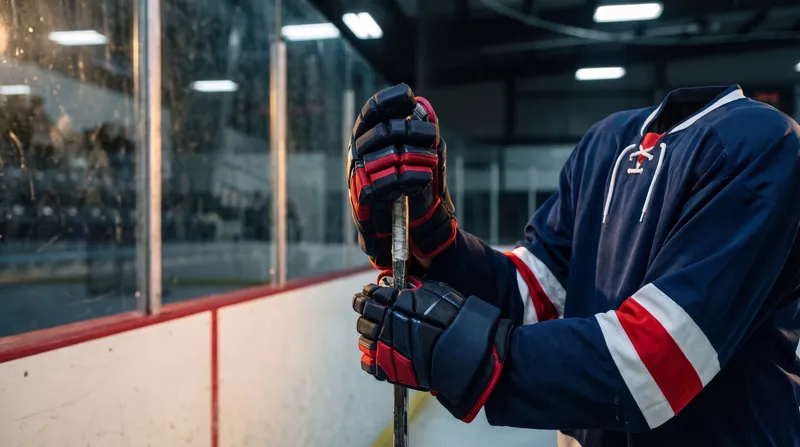
It's the bottom hand that decides, not the writing hand. Right hand at the bottom of the shaft: right-handed stick. Left hand at the bottom: left-handed stick (Bauer). For a child just starting, two simple tests help: which side they naturally swing a baseball bat from, and which side they naturally push a puck or a tennis ball from.
It is often noticed that a person who is left-handed in daily life plays right in hockey, and the other way around. That is a tendency, not a rule: the player's comfort comes first.
How much does a hockey stick cost in 2026?
In Canada, a senior stick costs from about $110 for an entry model to $460 for the top of the line. The prices below are regular prices on the Canadian official sites of Bauer and CCM. Last year's models are often on sale at 25 to 50% off, a good deal for a player who breaks sticks or grows fast.
| Tier | Senior | Junior | Examples |
|---|---|---|---|
| Entry | $109.99 to $179.99 | $89.99 to $139.99 | CCM Ribcor Trigger 60, Tacks Recharge 70, Bauer Vapor Fly40, Supreme F40 |
| Mid | $229.99 to $299.99 | $189.99 to $229.99 | Bauer Vapor FlyPro, Supreme F50 Pro, Supreme Pro, CCM Ribcor Trigger Unleashed XT |
| Top end | $439.99 to $459.99 ($409.99 intermediate) | $259.99 to $309.99 | Bauer Vapor Flylite, Supreme Fuse, Proto2, CCM Jetspeed FT9 Pro, Tacks Recharge Pro |
| Youth and Tyke | not applicable | $69.99 to $79.99 entry, $219.99 to $239.99 top end | Bauer Vapor Tyke, Vapor Youth, CCM FTW Youth |
Swipe the table sideways to see every column.
Regular prices checked on October 30, 2026 on ca.bauer.com and ca.ccmhockey.com, before tax. Store prices and sales vary.
A pricier stick does not fix a wrong length or a flex that is too stiff. For a young player, an entry stick at the right size beats a $300 stick that is too long. To put the price in perspective, see the cost of a hockey season and when it pays to invest in gear.
No credit card required. The free plan stays free.
The right stick is the one that puts more shots on net. With RinkLog, every shot on net, missed or blocked is logged game after game: you can see whether the new stick changes anything.
No credit card required. The free plan stays free.
Frequently asked questions
How do I know if my hockey stick is too long?
Standing in skates, hold the stick upright in front of you, blade on the floor: if it goes past your chin, it is too long for most players. In shoes, the landmark is the nose. According to Warrior, a shorter stick gives better puck control, a longer one gives reach and slap shot power.
What flex should I use at 180 lb?
Half your weight gives 90, but makers advise softer: about 75 to 90. Bauer's calculator suggests 80 for a 5'10" player. In 2026 Bauer sells 77 and 87 in senior, CCM 75 and 85. A wrist shooter should take the softer one.
Does cutting a stick change the flex?
Yes, it stiffens it: about 3 flex points per inch cut (2.5 to 5 depending on the source), or about 1 point per centimetre. A 70 cut by 2 inches behaves like a 76. An extension does the opposite and softens the stick. The scale printed on the shaft of most Bauer, CCM and Warrior sticks gives the exact figure.
What is the difference between a junior and an intermediate stick?
Length and flex. At Bauer in 2026, a junior is 50 to 54 inches in flex 30, 40 or 50; an intermediate is 58 inches (57 for the Fly40) in flex 55 or 65. Intermediate usually fits players aged 11 to 16 who are 4'6" to 5'3". A tall but light child can fall between the two: that is where cutting and extensions come in.
What size stick for a child?
Start from height, not age. According to Ice Warehouse, most children under 7 play with a Youth stick (about 46 inches, flex 20) or a Tyke (42 inches, flex 10), then a junior from about 6 to 12. Sherwood advises cutting the stick at eye level at the start of the season and replacing it once it drops below the mouth. As Warrior puts it, kids need a soft flex.
What stick curve is best for a beginner?
A versatile mid curve, like Bauer's P92 or CCM's P29, suits most beginners. For the youngest, Bauer makes the P28Y, a long, flat blade with a curved toe that helps lift the puck. According to Warrior, a shallow curve helps passing and accuracy, a deep one helps lift the puck.
How do I know if I shoot left or right?
Look at your bottom hand on the shaft: right hand low, right-handed stick; left hand low, left-handed stick. It is not always your writing hand. The baseball bat test (which side you naturally swing from) is a good hint for a child just starting.
Why don't all hockey stick flex charts agree?
Because makers and some retailers don't start from the same principle. Bauer caps at 87 and advises a little less than half your weight; some retailers offer 100 to 115 to heavy players. Lengths also change from brand to brand: an intermediate is 58 inches at Bauer and 55 to 57 in CCM's chart. Go by the chart of the brand you buy, then check against your chin.
References
Every number on this page comes from one of these sources. The links lead to the original text.
Bauer Hockey
Fiches produit des bâtons Supreme Fuse, Vapor Flylite, Vapor Fly40, Supreme F40, Vapor Tyke, Youth et Junior
ca.bauer.com
Source of lengths per flex (42 to 62 in), of the flexes sold in 2026 (65, 70, 77, 87 in senior), of the Vapor (low) and Supreme (mid) families, and of regular prices in Canadian dollars.
Read itBauer Hockey
The Ultimate Hockey Stick Buying Guide
bauer.com, blogue Learn
Source of the nose (in shoes) and chin to lower lip (in skates) landmarks, of the flex "a little less than half your weight", of the effect of cutting and of the bottom-hand rule.
Read itBauer Hockey
Flex guide et calculateur de flex
bauer.com
Source of the official calculator (5'10" and 180 lb: 80; 6' and 200 lb: 87; capped at 87) and of the measuring diagram from blade heel to shaft end.
Read itCCM Hockey
Bâtons CCM et fenêtre « Find your curve » (fiche Ribcor Trigger 60 Junior)
ca.ccmhockey.com
Source of the CCM flex and length chart, of the P28, P29, P88 (closed) and P90TM curves, of the Ribcor, Jetspeed and Tacks families, and of regular prices.
Read itCCM Hockey
Hockey stick flex
ccmhockey.com (Suède, en anglais)
Source of CCM's figure for cutting: about 5 flex points per 5 cm.
Read itWarrior Hockey
Hockey Stick Buying Guide
warrior.com
Source of the chin to nose landmark in skates, of the half-your-weight starting point, and of the "you can cut it, not add it back" rule.
Read itSherwood Hockey
PLAYRITE, conseils pour les jeunes joueurs
sherwoodhockey.com
Source of the growth rule (cut at eye level at the start of the season, replace once the stick drops below the mouth) and of flex equal to half the body weight.
Read itIce Warehouse
How to Select a Hockey Stick Size and Flex
icewarehouse.com
Source of ages, heights and weights by category, and of the practice of going 10 to 15 points under half the weight (180 lb: 75 to 80). Its Warrior Alpha, Covert, Novium comparison, updated October 2026, gives the Warrior kick points.
Read itHockey Monkey (2024)
Hockey Stick Sizing and Buying Guide
hockeymonkey.com
Source of the length-by-height ranges used by the tool, of curve principles and of the baseball bat test. Its companion flex page (2022) gives 3 to 5 points per inch cut and the Tyke player profile.
Read itHockeyStickMan (2015)
The Truth About Hockey Stick Flex
hockeystickman.com
Source of the 3 flex points per inch cut, of the stronger effect on junior and intermediate sticks, of pro stock sticks and of the weight rule's limits for shorter players.
Read it
The free plan lets you create a player and track their games with no credit card.
Create my free accountOn the same topic
- Hockey stick kick point: what the brands promise, what the research measuresLow, mid or hybrid kick: where the stick flexes, what the research actually measured, every 2026 line by brand and kick point, and how to choose yours.
- Hockey stick curve chart: every 2026 pattern, cross-brand equivalents and blade lie, with real measurementsEvery 2026 blade curve by brand, P92 equivalents at CCM, Warrior and True, blade lie explained, and an animated comparer to pick your curve on facts.
- What is SCF% (Scoring Chance For percentage)?SCF% measures what share of scoring chances belongs to your team while the player is on the ice: formula, thresholds (52%, 48%) and example.
- What is xG (expected goals) in hockey?xG (expected goals) assigns each shot a scoring probability based on its zone and type. Understanding Finishing and a goalie's GSAx.
- What counts as a scoring chance?Defining a scoring chance before counting it: the usual criteria (slot, odd-man rush, point-blank shot) and the golden rule of consistency.