No credit card required. The free plan stays free.
On this page
- What hollow should I get for my weight?
- 1/2 vs 5/8 hollow: what is the difference?
- Hollow vs profile: what is the difference?
- How often should you sharpen hockey skates?
- How do you know your skates need sharpening?
- What sharpening does a goalie need?
- 2026 blades and holders: which steel fits which skate?
- Does a good sharpening really make you faster? What the Brock study found
- What should you ask the sharpener?
- Frequently asked questions
What hollow should I get for my weight?
Weight comes first, because it presses the blade into the ice. A light player needs a deeper hollow to get the same grip; a heavy player bites enough with a flatter one. That is the principle CCM gives, without a number; the ranges below come from sharpening shops and retailers.
| Weight (lb) | Weight (kg) | Suggested hollow | Why |
|---|---|---|---|
| Under 100 lb | Under 45 kg | 1/2 in | high bite, for lighter players |
| 100 to 180 lb | 45 to 82 kg | 1/2 to 5/8 in | 1/2 for more bite, 5/8 for more glide |
| Over 180 lb | Over 82 kg | 5/8 to 3/4 in | heavier players bite enough with a flatter hollow |
Swipe the table sideways to see every column.
When in doubt, start at 1/2 in: it's the starting point most sharpeners give. A heavier or more powerful player can then move to 5/8.
A starting point, not a rule. Ice quality, level of play and personal preference matter as much as weight.
1/2 vs 5/8 hollow: what is the difference?
The bottom of a blade is not flat: the grinding wheel cuts a groove that leaves two edges, one inside and one outside. The hollow number (the radius of hollow, or ROH) is the radius of the circle that cut the groove. A small radius cuts a deep groove with tall, sharp edges. A large radius cuts a flat groove with lower edges.
Hence the rule to remember: the smaller the number, the more the skate bites. A 1/2 in (12.7 mm) hollow grips better in turns and stops but slows the glide slightly. A 5/8 in (15.9 mm) hollow glides farther on every push, with a bit less grip. In hockey, most players sit between 3/8 and 5/8 in.
3/8 in (9.5 mm)
Extreme bite, for very light players or those who ask for it. A niche choice: the blade can grab and slow you down.
1/2 in (12.7 mm)
The classic starting point. Suits kids, beginners and many average-weight adults.
5/8 in (15.9 mm)
More glide, less drag. A frequent choice for heavier or more powerful players.
3/4 in (19.1 mm)
A flat hollow, for heavy players who bite enough with their weight.
Change one step at a time, and give yourself two or three skates before judging: the first session on a new hollow always feels a little strange.
Hollow vs profile: what is the difference?
People often mix them up at the counter. The hollow shows in cross-section: the groove under the blade, measured in inches. The profile shows from the side: the curve of the blade from front to back, measured in feet, which decides how much steel touches the ice. Profiling is a separate job, done on a machine that gives the blade a precise shape.
| Profile | Effect on the ice |
|---|---|
| 9 ft | Less steel on the ice: more agility, tighter turns |
| 10 ft | Common, middle-of-the-road profile |
| 11 ft | A balance between agility and stability |
| 13 ft | More steel on the ice: more stability and glide |
| Quad (ProSharp Quad 0, I, II, III) | Several radii combined for transitions, starts and balance; aimed at competitive players |
| Ellipse (ProSharp) | An elliptical shape instead of circular arcs |
Swipe the table sideways to see every column.
The effects described come from machine makers and retailers; no radius is better in absolute terms.
CCM gives a simple rule: for kids and beginners, a standard single-radius profile; for experienced players, a custom profile; for elite players, combined radii based on position and style. A U9 kid does not need a Quad. They need blades that are sharpened often.
How often should you sharpen hockey skates?
Guidelines contradict each other when counted in weeks, because a hockey week means nothing on its own: one player skates an hour, another six. Count in hours of ice time instead. Here is what the sources say, from strongest to weakest.
| Player | Guideline | Strength of the source |
|---|---|---|
| Young player | Once a week, ideally before a game | Manufacturer (CCM) |
| Recreational player | Every 10 to 20 hours of ice time | Range most often cited by retailers |
| Competitive player | More often, commonly cited at 5 to 10 hours | Sources disagree |
| 3 or more sessions a week | Every 1 to 2 weeks | Single source |
| 1 to 2 sessions a week | Every 3 to 4 weeks | Single source |
| Outdoor or rough ice | More often than on indoor ice | Consistent |
Swipe the table sideways to see every column.
Count your hours, not your weeks: a blade wears on the ice, not on the calendar.
The simplest method: write down the date of your last sharpening, then add up the sessions since. If you keep your games and practices in RinkLog, the calendar already holds them; it won't send you a sharpening reminder, but the count takes a glance. The ice time guide explains how to estimate what one game represents.
How do you know your skates need sharpening?
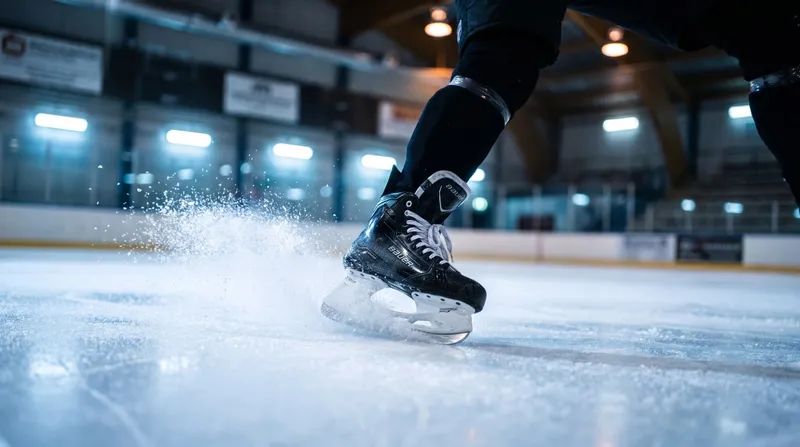
The skate tells you before the calendar does. These signs come up with every sharpener:
- The skate slides sideways in turns or stops instead of holding its edge.
- Tight turns take more effort, or the skate refuses to cut.
- Chatter: the blade skips or vibrates instead of gliding cleanly.
- Balance goes more easily, especially on the outside edges.
In a child, these signs often pass for fatigue or a lack of skill. A kid falling more than usual in turns deserves a look at their blades before a lecture. That is also why CCM aims for a weekly sharpening for young players: they can't yet tell when a blade is worn.
What sharpening does a goalie need?
A goalie doesn't skate like a player: they push sideways and slide on their edges to track the puck. A hollow that is too deep grabs during those slides. So goalies get a shallower hollow than skaters, often around 1 in or more according to one specialty retailer.
That is a single source, and preferences vary a lot from goalie to goalie. Start there, then adjust with your sharpener by feel: if lateral pushes lack grip, go a little deeper; if the skate grabs in slides, go flatter. The rest of a goalie's gear has its own rules, covered in goalie equipment sizing.
2026 blades and holders: which steel fits which skate?
Steel gets replaced several times over the life of a skate, since every sharpening removes a little metal. You still need the right one: the steel must be made for your skate's holder, not just its brand.
| Skates | Holder | Compatible steel | Good to know |
|---|---|---|---|
| Bauer skates with Powerfly (2025 Vapor, 2026 Supreme flagship) | Powerfly | Fly-Ti, Fly-X only | LS4 and older LS steel do not fit; Bauer does not mention LS5 |
| Bauer, previous models | Tuuk Lightspeed Edge | Fly-X, Fly-Ti, Carbonlite and the LS range | According to Bauer |
| CCM Jetspeed and Tacks | SpeedBlade XS (dial lock) | XS1, XS1 Black, Step Black XS depending on the model | One retailer says the XS holder fits CCM skates from 2019 on: confirm in store |
| 2026 CCM Tacks XR | XS | Step steel according to one retailer, XS1 Pro Black in youth | Not confirmed by CCM: check the model page |
| True (TF7, TF9, Catalyst) | True holder | Shift steel | According to True |
Swipe the table sideways to see every column.
Checked on October 30, 2026 on manufacturer and retailer pages. Bring your skate to the store: it is the only way to be sure.
New steel often arrives unsharpened, or with a basic sharpening: ask for your usual hollow before you skate again. To see whether premium steel is worth the price for your use, read is it worth investing in hockey gear.
Does a good sharpening really make you faster? What the Brock study found
It is one of the few studies on the topic. In a master's thesis submitted at Brock University (Ontario) in 2016, L. Cadeau had 40 hockey players (21 U16, 10 U18 and 9 Minor Midget AAA) skate 8 timed drills on two different sharpenings.
The result: the “recommended” sharpening produced faster times on 4 of 8 start measures and on 2 of 8 total times, with statistical significance (p < 0.05). On the other measures, the gap was not significant.
Two limits to keep in mind. First, the recommended sharpening combined three settings, profile, hollow and pitch (whether the curve leans forward or back): the study cannot say which one made the difference, and hollow alone was not isolated. Second, it is a thesis on 40 young players, not a universal rule. What you can honestly take from it: a well-matched sharpening can improve starts, and it is worth thinking about before a tryout camp.
For full camp preparation, see preparing for hockey tryouts.
What should you ask the sharpener?
Ask for your hollow by its number (“1/2”, “5/8”) rather than “the usual”: a new shop does not know your usual. Three habits are enough to get the same result every time.
Step 1: Name your hollow
Give the number (1/2, 5/8) or ask for last time's. Without instructions, the shop uses its house setting.
Step 2: One change at a time
Change the hollow OR the profile, never both together: otherwise you cannot tell what made the difference.
Step 3: Write down the date
Write down the date and the hollow, then count the hours of ice time until the next sharpening.
And if you are buying new skates, size comes before everything else: a perfect sharpening cannot save a poorly fitted skate. The hockey skate size chart gives the size and fit by model.
RinkLog measures and computes all of this automatically during your hockey, ball hockey and ringette games.
No credit card required. The free plan stays free.
Frequently asked questions
What hollow should a kid or a beginner use?
A 1/2 in hollow, the starting point most sharpeners give. Kids under 100 lb need a deep hollow to bite into the ice despite their low weight.
Is a 1/2 hollow more aggressive than 5/8?
Yes. The smaller the number, the deeper the hollow and the more the edges bite. A 1/2 in hollow gives more grip in turns and stops; 5/8 in gives more glide. Players from 100 to 180 lb often sit between the two.
How often should recreational players sharpen their skates?
About every 10 to 20 hours of ice time, the most commonly cited range. Sharpen sooner if the skate slides sideways, chatters or refuses tight turns, and more often on outdoor ice.
Does profiling replace sharpening?
No, they are two separate jobs. The profile sets the curve of the blade from front to back, in feet; the hollow is the groove under the blade, in inches, recut at every sharpening.
What hollow do goalie skates need?
A shallower hollow than a skater's, often around 1 in or more according to one retailer, so the goalie can slide without grabbing during lateral moves. Adjust with your sharpener by feel.
Do you need new steel when the blade wears down?
Yes, and that is normal: steel gets replaced several times over a skate's life, the boot does not. Buy steel made for your holder (for example Fly-Ti or Fly-X for a Bauer Powerfly).
References
Every number on this page comes from one of these sources. The links lead to the original text.
CCM Hockey
How to sharpen your skates
ccmhockey.com
Hollow principle by weight, profiles by level, and a weekly sharpening for young players, ideally before a game.
Read itCadeau, L. (2016)
Master's thesis on skate sharpening and skating performance
Université Brock (Brock University Digital Repository)
40 U16, U18 and Minor Midget AAA players, 8 drills; recommended sharpening faster on 4 of 8 starts and 2 of 8 total times.
Read itSparx Hockey
Understanding radius of hollow
sparxhockey.com
Explanation of radius of hollow and of 9 and 10 ft profiles.
Read itSports Plus Denver
How to choose the right hollow for skate sharpening: a skater's guide to performance and control
sportsplusdenver.com
Hollow choice by type of player, including the shallower hollow (1 in or more) for goalies.
Read itHockey Response
How often should you sharpen your ice skates?
hockeyresponse.com
One of the most visible frequency guides; ice-time guidelines vary from one guide to the next.
Read itBauer Hockey
Powerfly holder
bauer.com
Powerfly holder: compatible with Fly-Ti and Fly-X steel only.
Read it
The free plan lets you create a player and track their games with no credit card.
Create my free accountOn the same topic
- Hockey skate size chart: size, fit and the real differences between modelsFind your hockey skate size from your foot in cm or inches, decode Bauer Fit 1, 2, 3 and CCM fits, and compare Vapor, Supreme, Jetspeed and Tacks.
- Is top-of-the-line hockey gear worth it? It depends on how often you skateCost per session of skates, sticks and helmets by tier and by how often you play. Where to spend, where to save, used gear and warranties, with real numbers.
- How much does a season of youth hockey cost in Quebec?Youth hockey registration fees by age group, AA and AAA extras, tournaments, sharpening, gear and financial help: the real budget of a season in Quebec.
- Beginner hockey equipment list: what to buy, in what order, at what priceThe 12 pieces of beginner hockey gear in the order you put them on, what is mandatory, what a first set costs, and what you can safely buy used.
- Hockey age groups explainedEvery hockey age group in one table: U7 to U21 (Canada), 6U to 18U (USA), M7 to M18 (Quebec), Mite to Midget, France, Switzerland, Sweden, IIHF. Find your child’s label.