
No credit card required. The free plan stays free.
On this page
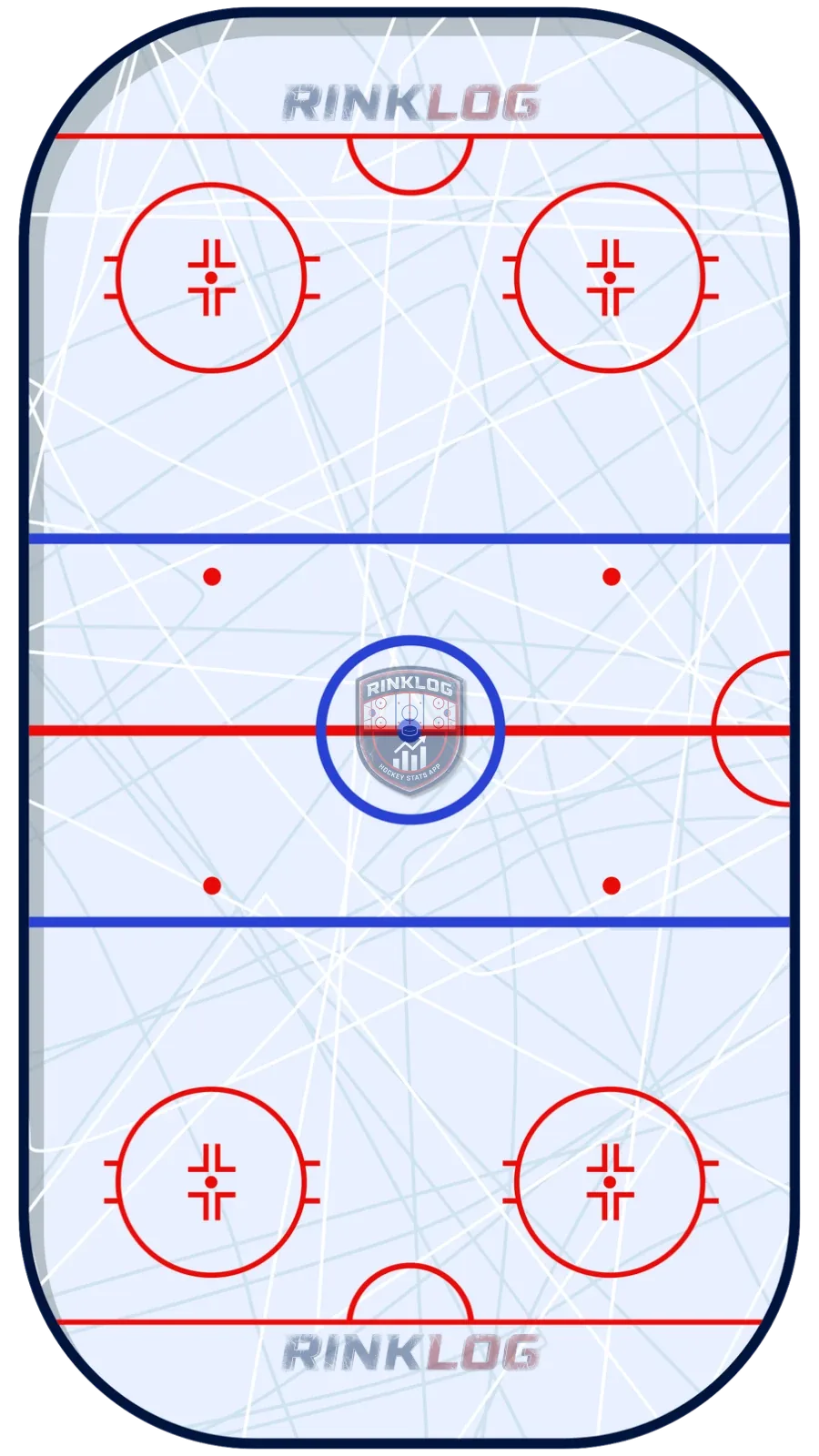
Phase 1 / 3Defensive zone
The diamond forms once O4 sets up with the puck and slides laterally along the blue line, looking for an opening to pass central. F1 stands in his shooting lane, D1 is ready to cover O2, F2 sinks toward O5 and D2 holds the net.
- Our team
- Opponents
- Pass
- Shot
- Puck
The shape gives the system its name: four players arranged in a diamond around the mobile carrier, each assigned a direction, high, low or lateral, without ever breaking the shape. The player closest to the puck stays in the shooting lane as long as the carrier stays central on the blue line, ready to either press or simply contain depending on the distance.
The manual describes two close variants, triggered by different puck movements. The Czech press answers a passing play between the point and a player on the half-wall: the relay between the two high players becomes the key, one presses while the other covers, never both at once. The low-high press answers a pass moved up from below to a defenseman receiving along the wall: the player stepping up presses immediately along the boards while a teammate stays ready to intercept the return feed.
The diamond's strength lies in precision: unlike the box, which moves as one block regardless of the situation, the diamond concentrates its four players exactly where the threat is. Every player keeps an active stick in the most dangerous passing lane, usually the slot or the weak-side defenseman.
The gap is implicit but clear: as long as the carrier stays central on the blue line, the formation holds. The moment he leaves that spot, through a marked lateral move or a quick feed, the diamond is no longer aligned and has to scramble to readjust. That is exactly the window a power play tries to open, and a quick give-and-go between two players before the pressure arrives can be enough to create it.
The Czech press has its own classic error: a player pressing too early, before the pass arrives at the same moment, leaves the slot open. The relay between the two high players has to stay synced to the tempo of the puck, not to anticipation.
The diamond's shape stays visible even when the puck barely moves: four players in a diamond rather than a square, concentrated around one carrier. Watch instead who presses and who stays in coverage: their relay tells you whether the read is holding or has just broken. A diamond can look solid and still give up a central lane; the shots allowed, located by zone in RinkLog, say so without argument.
- The diamond triggers off a read, not off the clock
- Only one player presses at a time, never two at once
- Every player keeps his diamond role without breaking the shape
- The gap opens the moment the carrier leaves the center of the blue line
RinkLog measures and computes all of this automatically during your hockey, ball hockey and ringette games.
No credit card required. The free plan stays free.
Frequently asked questions
Diamond or box: when do you use which?
The box stays the default formation for most sequences in the zone. The diamond answers one specific situation, a carrier sliding with the puck along the blue line, and demands a finer read from all four players.
What is the Czech press?
A diamond variant triggered by a vertical passing play along one wall, between the point and a lateral player. Two players relay the pressure so neither ever steps up at the same time, which keeps the slot covered.
The free plan lets you create a player and track their games with no credit card.
Create my free accountOn the same topic
- What is the penalty kill box?The penalty kill box explained: four compact killers, the retreating box that gives up the outside, its strengths, weaknesses, and how it gets beaten.
- What are the penalty kill forecheck systems?The five penalty kill forecheck systems: tandem pressure, forwards wide, the retreating box, same-side press, and the passive 1-3, compared.
- How does a hockey penalty kill work?How a hockey penalty kill works: face-offs, forecheck systems, the box, the diamond press, five on three, and what makes a great penalty killer.